Centre d'apprentissage 3D

Waterproof 3D Printing: Tests and Recommendations for Manufacturing Submersible Parts

Key takeaways:

  • Waterproofing in 3D printing is a critical challenge for manufacturing parts intended for immersion, especially in extreme environments.

  • Not all materials perform equally only certain polymers can truly ensure waterproofness under pressure.

  • In tests up to 8 bars, polypropylene (PP) demonstrated total waterproof performance, unlike PA11 and PA12, which absorbed some water.

  • Material selection, assembly design, and best manufacturing practices are key to producing truly waterproof 3D printed parts.

Why waterproofing matters in 3D Printing

Waterproofing has become a growing requirement in 3D printing, especially in industries where printed parts are exposed to water, pressure, or humidity over long periods. This includes both technical applications like electronic housings and embedded sensors and consumer uses such as reservoirs.

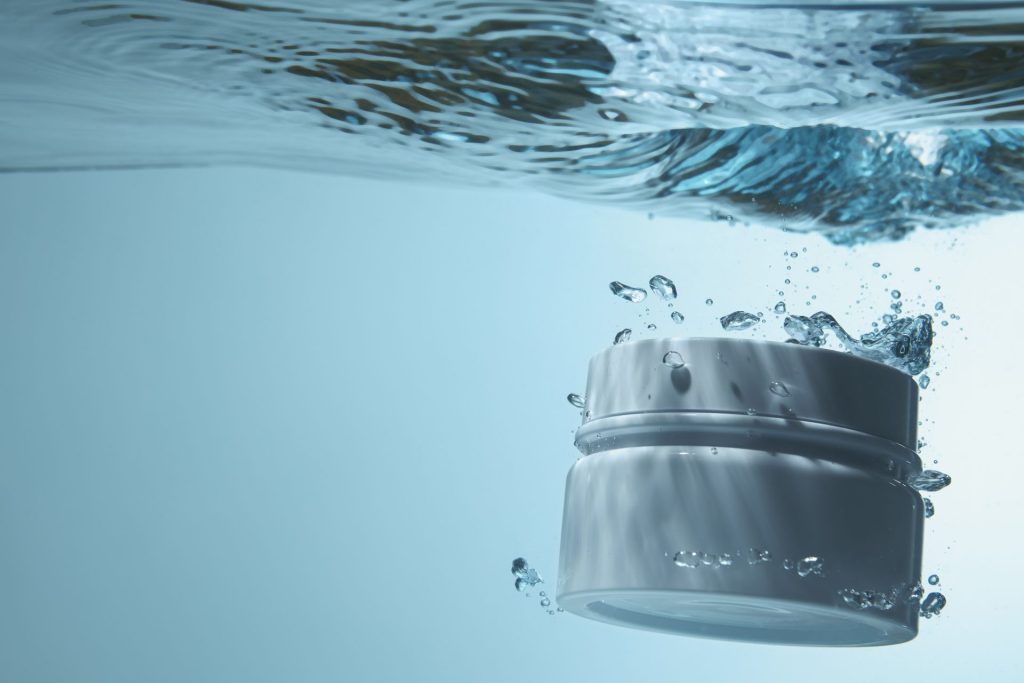
pièce étanche imprimée avec des gouttes d'eau

To meet this industrial need, Sculpteo conducted an in-depth testing campaign in partnership with First Texas Products, manufacturer of Fisher metal detectors.

The goal: to determine whether modern 3D printing technologies and materials can produce fully waterproof parts, even under prolonged immersion at simulated depths of 100 meters.

Methodology: High-pressure waterproof testing

The tests were conducted in a stainless steel pressure chamber, filled with freshwater and pressurized using a compressor reaching up to 10 bars (equivalent to 100 meters of depth). The 3D printed parts had a 2 mm wall thickness and featured an A55 silicone O-ring (Ø ext. 47 mm / Ø int. 41 mm / thickness 3 mm), inserted into a groove and compressed with a screwed PMMA plate.

All configurations were tested with and without dielectric silicone grease. Waterproofing was confirmed if:

  • No water infiltration was visible on the indicator paper
  • No water absorption was detected, measured using precision weighing (±0.01 g) and a digital hygrometer (±0.1%).
Coupe de la chambre en inox
la pièce test avec joint et papier témoin

Materials and configurations tested

The tests focused on six material variants: raw polypropylene, smoothed polypropylene, raw PA11, smoothed PA11, raw PA12, and smoothed PA12

For each material, the parts were tested in different assembly configurations, with or without silicone grease, in order to simulate realistic mounting conditions.

Caractéristiques des pièces

Details of applied pressure cycles

Each part was subjected to a progressive pressure increase in the test chamber. The trials began with 2 bars of pressure for 24 hours, followed by an additional 48 hours at the same pressure.

Next, the pressure was raised to 4 bars for 24 hours, then held for another 48 hours.

Finally, the parts were exposed to 8 bars for 24 hours, and again for 48 hours.

This protocol was designed to evaluate not only immediate resistance to pressure, but also the long-term sealing stability under sustained stress. The gradual escalation ensures a reliable and thorough assessment of waterproof performance.

Test results: Clear differences between materials

Polypropylene (PP): The Ideal Material for Waterproof 3D Printed Parts

Polypropylene (PP) whether raw or smoothed, with or without silicone grease passed all tests without any infiltration. Every sample showed water absorption below 0.01%.

The parts remained completely dry on the inside, even after 48 hours of immersion at 8 bars of pressure. This consistent performance over time and under stress makes PP a benchmark choice for parts that need to stay sealed during long-term immersion.

PA11 and PA12: Water Absorption Too High

Parts printed in PA11 and PA12, even when smoothed and used with silicone grease, all showed water absorption above 5%, making them unsuitable for assemblies that must remain waterproof over time.

No visible leakage was detected, but the materials themselves absorbed moisture, compromising long-term durability. Secondary sealing solutions like coatings or varnishes are possible but tend to be complex, costly, and unreliable in the long run.

Feature / Material Water Absorption (avg.) Leak Detection (paper test) Suitable for Long-Term Immersion Performance at 8 bars / 48 h Effect of Smoothing Effect of Silicone Grease Compatibility with Water Exposure
Polypropylene (PP) < 0,01 % 0% (no infiltration) 100% (all cycles passed) Passed Negligible on sealing, improves cleanability Improves sealing (on joint only) Fully compatible with long-term immersion
PA11 5,4 % – 6,3 % 0% (no infiltration) 0% (absorbs moisture) Paper remained dry Negligible on sealing, improves cleanability No effect on absorption Compatible with short-term immersion or splashes
PA12 5,7 % – 6,8 % 0% (no infiltration) 0% (absorbs moisture) Paper remained dry Negligible on sealing, improves cleanability No effect on absorption Compatible with short-term immersion or splashes

Influence of surface smoothing, grease, and assembly design

The secondary findings from the tests are clear. Surface smoothing does not significantly affect the overall permeability of the part. Silicone grease helps improve the seal of the O-ring, but it does not prevent the material itself from absorbing water.

Lastly, in saltwater environments, it is essential to use compatible metal screws and inserts to avoid galvanic corrosion for example, using stainless steel screws with stainless steel inserts.

Practical recommendations based on use conditions

Pluie

For applications exposed to rain, splashes, or occasional humidity, PA11 or PA12 can be suitable provided that wall thickness, assembly design, and additional precautions are carefully controlled.

Immersion courte

In the case of short-term immersion, PA11 or PA12 may still be used, but users must accept a certain level of moisture absorption and systematically verify the waterproofness of each configuration.

Immersion longue

For situations involving long-term immersion, such as embedded sensors remaining underwater for several hours or days, only Polypropylene (PP) whether raw or smoothed has demonstrated reliable and lasting waterproofing.

Eau salée

Finally, for long-term immersion in saltwater environments, such as the ocean, PP stands out as the only suitable material, thanks to its hydrophobic properties and long-term chemical stability.

Application Condition Splashes / Rain / Outdoor Exposure Short-Term Immersion Long-Term Immersion Long-Term Immersion in Saltwater
Recommended Material PA11 / PA12 (with caution) PA11 / PA12 (limited use) Polypropylene (PP) Polypropylene (PP)

What sculpteo offers

At Sculpteo, we print using advanced technologies such as SLS and HP Multi Jet Fusion, and we specialize in post-processing techniques like chemical smoothing to ensure both mechanical performance and aesthetic quality.

While waterproof testing is not performed internally, our team relies on verified test data to provide you with expert guidance on material selection. Thanks to our extensive experience with a wide range of functional applications, we can help you identify the most reliable 3D printing solutions to ensure your parts meet the required performance criteria.

Not sure if your application is compatible with our materials?
We’re here to help. Our team can assist you in evaluating whether your process and conditions are suitable for using our materials, based on test-based insights and real-world experience.

Recevez les dernières actualités de l’impression 3D

Inscrivez-vous à notre newsletter pour tout connaître des dernières technologies d’impression 3D et de leurs applications, mais aussi des nouveaux matériaux et logiciels 3D.