
3D Learning Hub
Pawel Slusarczyk
PR Manager & Customer Success Manager @ Bambu Lab | AM Industry Insider | 3D Printing Historian

People of 3D Printing: Pawel Slusarczyk

Who is Pawel Slusarczyk?

I’m originally from Łódź, Poland, and I’ve been involved in 3D printing for over 13 years now, starting in early January 2013. Before entering this industry, I worked as a senior manager in IT and advertising, with a strong focus on sales and business strategy. I was always interested in understanding not just how a product works, but why it’s needed and how it can create real value.

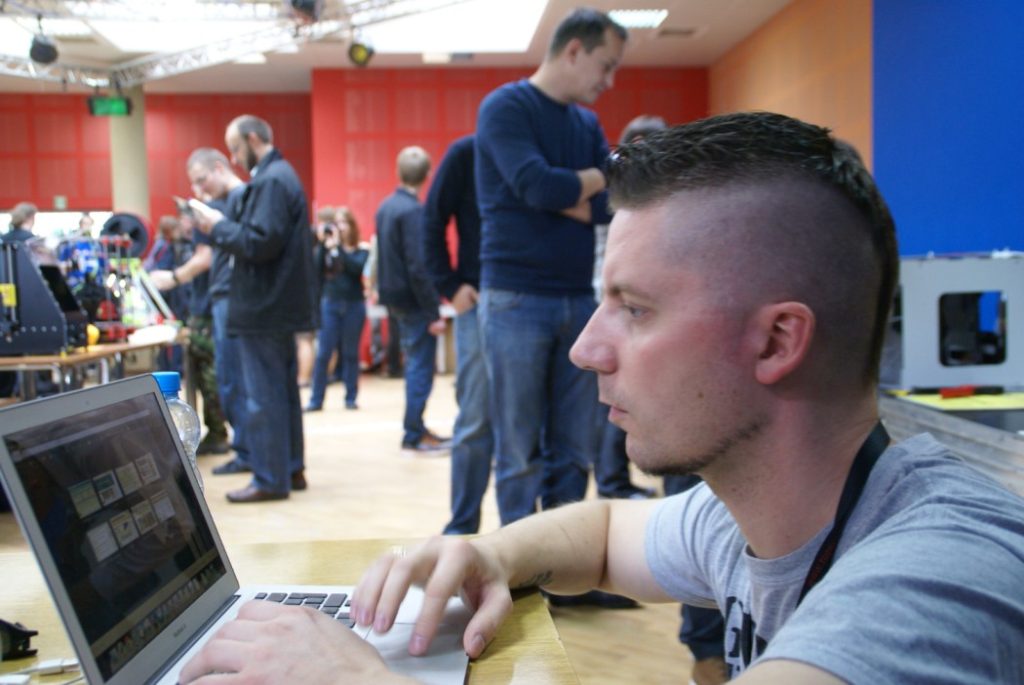
Image of Pawel in 2013

2013 – Dni Druku 3D (Days of 3D Printing) 

I discovered 3D printing during the early hype phase and initially wanted to sell 3D printers. To do that more effectively, I decided to create my own blog to promote them. That blog eventually grew into 3D Printing Center (Centrum Druku 3D), which became the largest and most influential 3D printing media platform in Poland at the time. 

What made it successful was that I focused on Polish companies and makers, at a time when most media were only translating stories from the US or Western Europe. Together with early Polish companies, we essentially helped build the local 3D printing ecosystem from scratch.

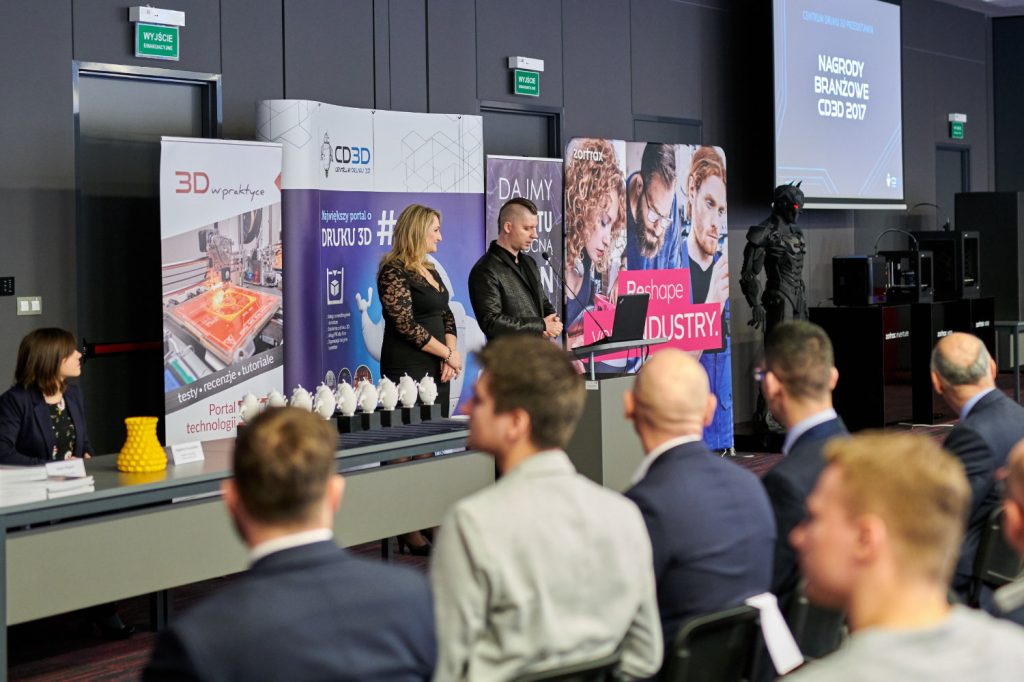
2018 –  CD3D Awards Gala.

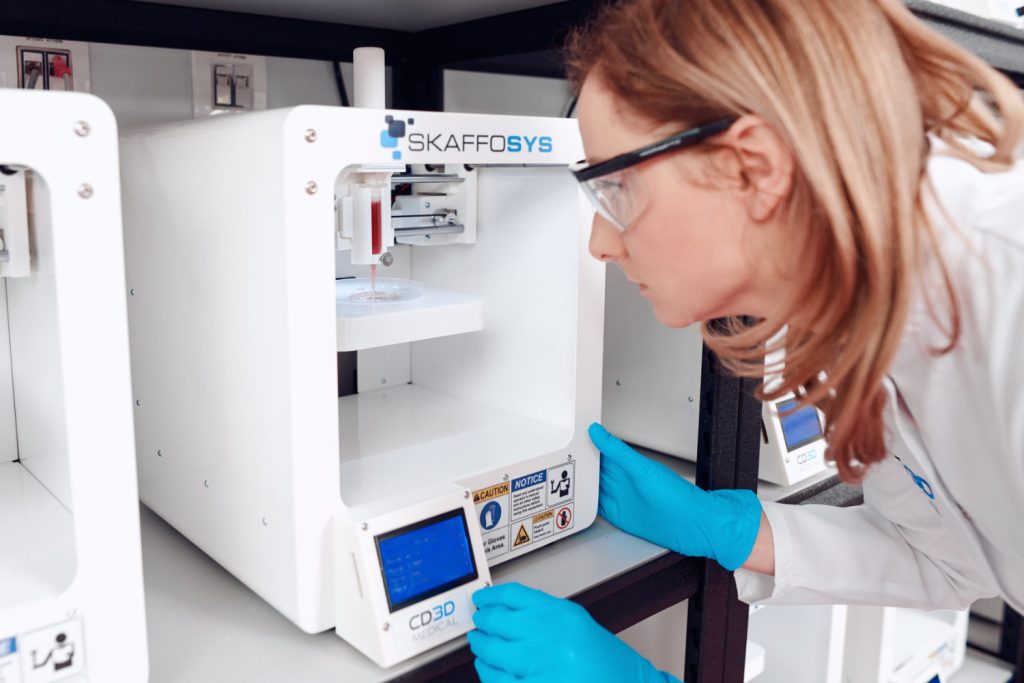
Over the years, the platform grew alongside the Polish additive manufacturing industry. I expanded into professional training, conferences, trade shows, and even organized Poland’s first 3D printing awards gala. My team and I were also involved in hands-on projects, including developing Poland’s first commercial bioprinter and later a biodegradable filament made from wheat bran, which was even used for large-scale advertising stands.

Despite still loving the technology, I became deeply disappointed with the industry itself. Many companies failed due to poor decisions rather than bad luck, both in Poland and globally. By 2023, after nearly a decade, I decided to step away and sold my media business. I then tried launching an interior finishing business that used 3D printing, but it failed completely, and I lost the money I had earned from selling the website.

Despite still loving the technology, I became deeply disappointed with the industry itself. Many companies failed due to poor decisions rather than bad luck, both in Poland and globally

In mid-2024, I returned to additive manufacturing in a different way. I didn’t want to go back to traditional industry reporting, so I started writing daily LinkedIn posts about historical events in 3D printing. I posted every single day for nearly a year. Eventually, I naturally returned to commenting on current industry news, using the same realistic, hype-critical approach I’ve always had. From the beginning, I’ve believed that 3D printing is powerful, but only in specific applications and niches, not as an overhyped consumer miracle.

As my writing gained traction on LinkedIn and Substack, industry insiders began sharing stories with me. I learned how to comment carefully and responsibly, knowing when and how to say things without crossing legal lines. Today, my journalism is more of a passion project than a business.

Professionally, I joined Bambu Lab last year as Customer Success Manager for Central Europe, covering regions from Poland to Greece. Later, I also started supporting the company on the PR side, combining both roles.

Looking back, I’m grateful for the journey. Coming from Poland, where the industry barely existed when I started, I try to stay humble and thankful for how things unfolded, without bragging, just appreciating the path that brought me here.

You have experience in Eastern & Western Europe. What difference do you see in adoption of 3d printing and where the barriers are in both cultures ?

I’m actually very proud of what has happened in Poland. During the so-called golden years of my media work, roughly between 2015 and 2018, the market was still very challenging. Writing articles alone was not enough to make a sustainable business, so we had to expand into trainings, conferences, and trade shows just to keep things going. At that time, there simply wasn’t much money in the Polish 3D printing media space.

What’s interesting is that after I sold the website, the market really took off. Today, Poland is one of the largest and most important additive manufacturing markets in Europe, especially when it comes to desktop 3D printers. While we still don’t have as many industrial-grade systems, such as metal or powder-based polymer printers, as Western countries like Germany, the adoption of desktop printers is incredibly strong and continues to grow.

Looking across Eastern Europe, the Czech Republic is a clear standout, largely thanks to Prusa Research, which acts as a strong local champion for the entire ecosystem. Romania, in my view, is not yet a major player, but I expect it to become very important within the next five years. Other countries such as Croatia or Serbia are harder to compare directly with places like Austria or Sweden, simply because their economies are smaller and more tourism-focused rather than industrial. Still, growth in 3D printing is happening everywhere.

Ukraine is a very special case. Given the current situation, there is enormous demand for 3D printers, as long as they are affordable. The way 3D printing is used there has fundamentally shifted manufacturing priorities, speed, cost, and scalability matter far more than long-term durability or high quality. In such conditions, products are designed to be used once, not to last. Even if the conflict eventually ends, I believe this kind of decentralized, rapid manufacturing will continue because uncertainty will remain high.

Western Europe naturally has more industrial installations and long-term investment capacity, while Eastern Europe has shown incredible flexibility, pragmatism, and speed of adoption

From a broader East-West perspective, Western Europe naturally has more industrial installations and long-term investment capacity, while Eastern Europe has shown incredible flexibility, pragmatism, and speed of adoption, especially at the desktop level. The main barriers differ accordingly: in the West, it’s often about integration, regulation, and return on investment, while in the East it’s more about access, price, and scale.

As for Bambu Lab, we deliberately distance ourselves from defense industries. Our printers may be used everywhere, but the company has always been focused on building the best possible consumer brand. That was the founders’ original goal, and it remains central today, even though the technology itself inevitably finds applications far beyond its original intent.

What technology gives you the strongest development hope for the upcoming years and why ?

2019 – the bioprinter SKAFFOSYS.

The technology that gives me the most hope for the coming years is filament-based 3D printing, mainly because of its simplicity. Resin and powder-based technologies will always have their place, just like metal extrusion technologies such as DED (Direct Energy Deposition) will remain important in specific industrial applications. But when it comes to real growth and scale, simplicity is the decisive factor.

Even companies that are willing to invest in 3D printing often hesitate because they’re unsure how they will actually operate the technology. I see this constantly. Just recently, I visited an industrial finishing company that was exploring 3D printing for prototyping and possibly for end-use parts. They showed me parts made using resin or powder-based processes like SLS or MJF. While they liked the results, they were immediately discouraged by the operational complexity. They didn’t want to deal with post-processing, chemical handling, or the infrastructure required for resin or powder systems.

When we discussed filament-based printers, the conversation changed completely. Yes, filament printers have limitations compared to resin or powder technologies, but many companies are willing to accept those compromises because the process is simple, clean, and accessible. These machines are essentially plug-and-play. You turn them on and start printing. What was promised 15 years ago by early desktop 3D printing pioneers is finally happening now, and that’s why we’re seeing such strong growth in desktop printer sales.

I strongly believe the market is splitting into two distinct paths: consumer 3D printing and traditional, hardcore industrial 3D printing. These two worlds will continue to diverge. Industrial companies will still buy consumer-grade machines, but the pace and scale of growth will be completely different. In just a few years, it won’t make sense to compare a company that proudly sells a few hundred industrial machines with one that sells hundreds of thousands of consumer printers. They are fundamentally different markets, even if they share the same name : 3D printing, and the same origins.

From a market perspective, they are no longer comparable, and filament-based technology is clearly at the center of this next phase of growth.

On a scale from 1 to 10, how would you rate the maturity of the overall 3d printing market

If I had to rate the overall maturity of the 3D printing market today on a scale from 1 to 10, I would say it’s still below 5. There is still a huge amount of room for growth. This is not a scientific measurement, it’s more of a gut feeling, but I strongly feel that something important happened between the third and fourth quarters of last year, especially in desktop 3D printing.

If I had to rate the overall maturity of the 3D printing market today on a scale from 1 to 10 it would still be below 5

Until recently, desktop 3D printing was mainly driven by makers and hobbyists. Companies were using printers, of course, but among private users it was still mostly people who already had technical skills or were part of the broader maker movement.

The growth of 3D printing followed the growth of that movement. What changed last year is that ordinary people, not just makers, started buying 3D printers in large numbers

And this wasn’t limited to one brand; it happened across the entire market. I believe most desktop printer manufacturers reached all-time sales records.

Today, people with very basic technical skills, those who might only be comfortable drilling holes in a wall, are buying and using 3D printers. I often compare this to kitchen robots like Thermomix in Europe. You don’t need to know how to cook. You just follow the app, click a few buttons, add ingredients, and you get restaurant-level results. The same thing is now happening with 3D printing. You find a model in an app, all the settings are ready, the files are optimized, supports are included, colors are already assigned, and you just load the filament and press print. Compared to just a few years ago, when users had to manually slice and optimize everything, the difference is enormous.

Because this shift is only just beginning, the consumer side of the market still has massive growth potential. As more non-technical users enter, the numbers will continue to rise.

On the industrial side, maturity is also improving, but in a different way. Many companies were disappointed in the past because 3D printing was marketed as a replacement for traditional manufacturing, which was never realistic. Once that hype collapsed and many over-promising companies disappeared, the market began to stabilize. Now, companies that already have 3D printing in place are learning how to use it properly, as a complementary technology, not a replacement. And when used that way, it turns out to be extremely valuable.

From an investment perspective, being a complementary technology is less exciting than being “the next big revolution,” which is why so much venture capital was misallocated in the past. But today, the market is maturing, and only companies with strong products, clear focus, and the right people are surviving. Formlabs is a great example of this. They survived the first wave of consumer 3D printing by shifting early toward professional and dental applications, and later expanding into powder-based systems. They made smart, focused decisions, and it paid off.

Ultimately, technology alone is not enough. The companies that succeed are the ones with strong teams and experienced people. I see this clearly at Bambu Lab as well. Great hardware and software matter, but people are the most important factor in building and growing a sustainable business.

You have been addressing software as one critical point for enabling the use of 3d printing. Do you still think this is a bottleneck ? In what sense? (Cost, ease of use, software not delivering the right value ?)

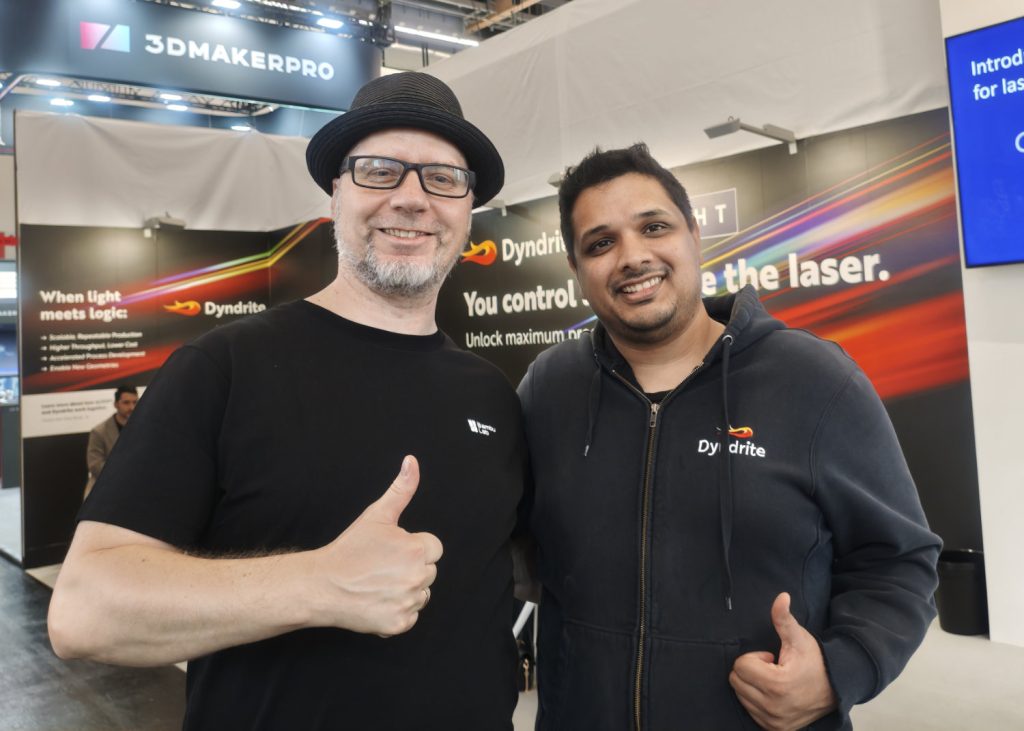
2025 – Pawel and Harshil Goel  from Dyndrite.

Yes, I still believe software is one of the biggest bottlenecks in 3D printing, and in many cases, it’s the decisive factor. To explain why, I have to give a lot of credit to Dyndrite. I met their team in late 2024, without fully realizing at first how important their work actually was. Only after spending time digging into what they were building did I understand the scale of the impact.

Metal 3D printing is basically the Formula 1 of additive manufacturing. It requires huge budgets, deep expertise, and extremely advanced processes. Yet for years, the software driving these machines was surprisingly primitive.

I’ve worked with metal systems myself and saw how much had to be done manually, supports, build preparation, and constant trial and error. What shocked me most was the failure rate. In metal AM, failure rates of 30–50% were not unusual, depending on the machine and material. That’s not something people talk about publicly, but everyone inside the industry knows it.

Printers are relatively easy to copy. (...) What truly differentiates companies is software

What companies like Dyndrite did was fundamentally different. They didn’t just create another slicer; they rebuilt the entire software engine from the ground up. By applying serious mathematics and software engineering, they made it possible to dramatically optimize metal printing processes. The result is that the same machine, often costing millions, can suddenly become far more reliable and economically viable. When failure rates drop from 50% to 15%, the technology starts to make sense for many more users. That’s when adoption really begins.

The same principle applies to desktop FFF printing. Mechanically, printers are relatively easy to copy. Any competent manufacturer can reverse-engineer hardware. What truly differentiates companies is software, and software is hard. It requires different skills, different people, and long-term investment. Many companies are excellent at manufacturing but have no real software culture, relying entirely on open-source solutions. There’s nothing wrong with open source, but you can’t scale indefinitely without adding your own value on top of it.

This is where companies like Bambu Lab stand out. The printer alone is not the reason people buy it, the ecosystem is. Software today is not just a slicer; it’s firmware, slicing, cloud platforms, model libraries, mobile apps, monitoring, sensors, cameras, and automated error detection. Everything works together. You browse a model, download it, all settings are ready, materials are predefined, supports and colors are done, you press print, and the system takes care of the rest. If something goes wrong, the printer stops and notifies you on your phone. This entire environment simply didn’t exist a few years ago.

Three years ago, people were still using modern printers in very old ways. High-speed printing was technically possible more than a decade ago, it wasn’t the bottleneck. The real limitation was everything around the machine. What has changed is not just hardware, but the software-driven user experience that makes 3D printing reliable, accessible, and scalable.

So yes, software is still a bottleneck, but it’s also the biggest enabler. Whoever solves software properly is the one who unlocks real adoption, whether in consumer or industrial 3D printing.

Everybody talks about AI - How do you believe it will revolutionize 3d printing, besides being able to print small figurines of yourself?

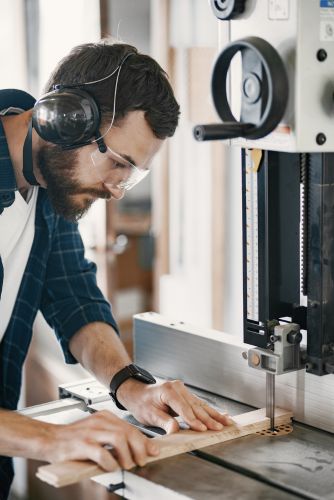
3D caning

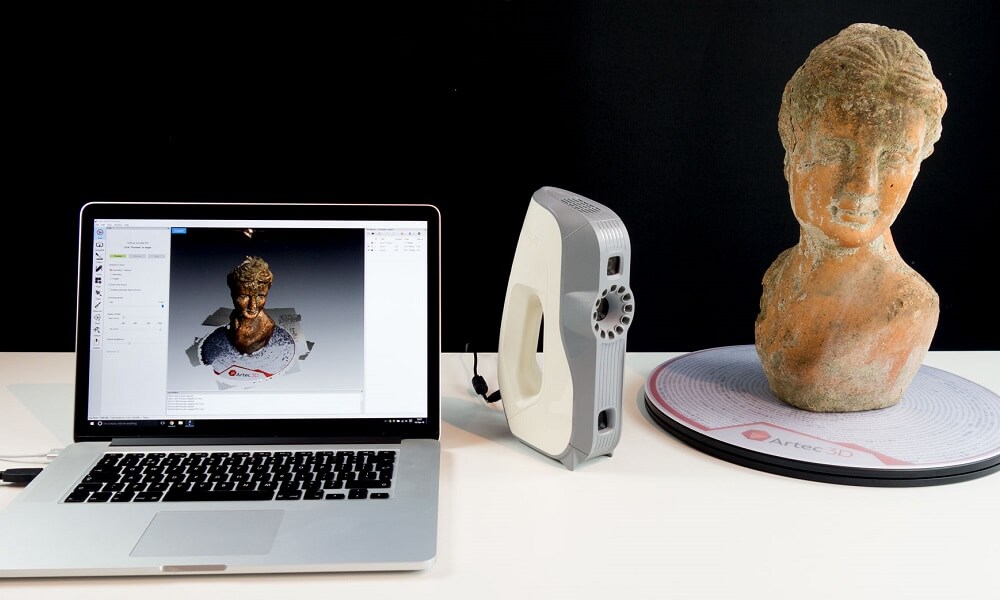
As usual, I’m quite immune to hype, and AI is obviously the big topic of 2024 and beyond. I did get genuinely interested when I started looking at Backflip AI, a tool created by the former Markforged founder. What really impressed me wasn’t the flashy side of AI, but something very practical: its ability to repair and clean up 3D scans. Anyone who has worked with scanning knows that capturing the scan is only the beginning, the real work starts afterward. If AI can significantly reduce that manual effort, that’s already a major step forward and a very real value for many industries.

I’ve also played a bit with consumer-oriented tools, like Bambu Lab’s app that turns a photo into a small 3D-printed figurine. It’s fun, and yes, you could technically build a small business around it—but it’s not revolutionary, and it’s not where the real future of additive manufacturing lies.

The reality is that 3D printing gets only a tiny fraction of global AI resources. AI development requires enormous investments : Data, energy, computing power, cooling infrastructure, and those resources are currently focused on much larger markets like video, image generation, text, and customer-service automation. Compared to those industries, 3D printing is still very small, which limits how much custom AI development can realistically be done for it.

This situation reminds me of why it took so long for good software to emerge in 3D printing in the first place. Back in 2015, we already knew the problem: the best software engineers were going to mobile, web, and big tech, not to additive manufacturing. The same thing is happening now with AI. The technology is being used in 3D printing, but mostly in limited, adapted ways, not through tools built specifically for the needs of additive manufacturing.

I’ve tested other AI tools as well, including Meta’s 3D model generator. These tools are clearly designed for gaming, advertising, or virtual environments, not for 3D printing. The models might look good on screen, but they are often unsuitable for printing. In comparison, Bambu Lab’s tools are more aligned with 3D printing, but they’re also very limited in what you can actually do with the generated models beyond printing them.

So my conclusion is simple: AI in 3D modeling and additive manufacturing is still waiting for its moment. Useful applications already exist, especially around scan processing, but the real breakthrough will only come when enough resources, talent, and purpose-built tools are dedicated specifically to 3D printing. Until then, AI will remain helpful, but not yet transformative, for the industry.

Which AM market segments are overhyped, and which are underestimated? Can you give us some real-life examples?

I don’t really think there is much hype left in additive manufacturing right now. In fact, I believe we’re going through what I’d call a necessary hype hangover. For years, we were all intoxicated by promises, possibilities, and big visions. That phase ended the way it had to, and now the industry is dealing with the consequences. It’s uncomfortable, but it’s also healthy, and unavoidable.

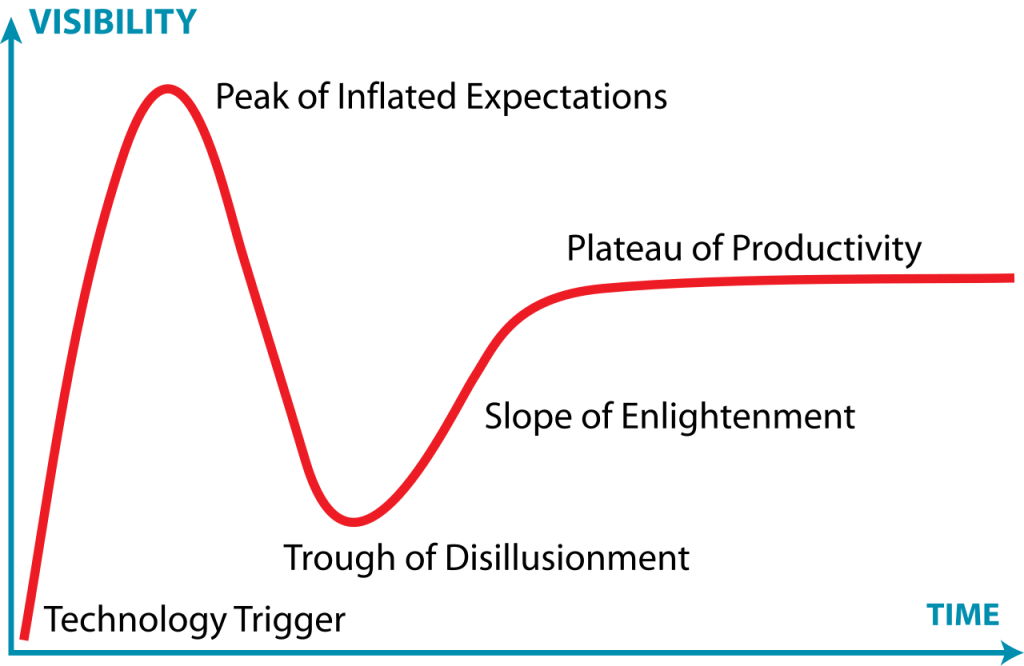
Gartner Hype cycle
Gartner Hype cycle

If you look at it through something like the Gartner hype cycle, we’re still coming out of the slope of disappointment. At the same time, we’re slowly entering a phase of more realistic, grounded growth across most segments. Because of that, I don’t see any area today that I would describe as heavily overhyped. Even AI, which I expected a year ago to become the next big hype driver in 3D printing, hasn’t really turned into a major hype wave yet.

Part of the reason for this is financial reality. Venture capital firms and other investors have become extremely cautious about anything that has “3D” in the name. And honestly, that’s a good thing. The era of selling visions, promises, and “future potential” is largely over. Today, you actually have to build something that works, something useful, and something that delivers real value.

That doesn’t mean nothing exciting is happening—quite the opposite. There are many interesting developments across different verticals of additive manufacturing. But these are mostly quiet, practical advances, not hype-driven narratives. Real growth is still at an early stage, and it’s happening through solid applications rather than big marketing stories.

So if I had to summarize it: we’re past the hype, we’re recovering from it, and what comes next is slower, more realistic, and ultimately much healthier for the industry.

How has your perspective on AM changed since you first entered the field?

Many of the shady companies and individuals are gone, not all, but most. What remains are real businesspeople, real engineers, and real inventors. For the first time, I believe we’re entering the best and healthiest period this industry has ever seen

When I first entered additive manufacturing, my background was in advertising and IT. I worked with relatively small companies, but on very large projects and budgets, often for major clients. Unfortunately, when big money is involved, you inevitably encounter questionable practices and corruption. I reached a point where I simply didn’t want to be part of that world anymore, even though I had a good position and was earning very well.

That’s why 3D printing felt so appealing at the beginning. It was fresh, raw, and full of young engineers and entrepreneurs who genuinely wanted to build something new. Most of them were in their early twenties, while I was in my early thirties, which naturally put me in a mentoring role. One of the reasons I was successful early on was that I could help these teams understand sales, communication, and how to position themselves in the market.

What disappointed me deeply was how quickly the industry became corrupted as well, sometimes even faster than the sectors I had left. When money was scarce, some people started taking shortcuts, and in a few cases, crossed into outright criminal behavior. Others didn’t steal, but they overpromised massively, raising money on unrealistic visions and then wasting it irresponsibly. For a long time, I thought this was a problem specific to Poland or post-communist markets. Eventually, I realized it was a global industry-wide issue, from top to bottom.

That realization was the breaking point for me. I decided I didn’t want to be part of this anymore. Ironically, when I returned to the industry, it was right at the moment when everything started to collapse. I was among the first to openly say that the ship was sinking, even while many people were still insisting everything was fine. Time proved that assessment right.

Now, after that collapse, the situation is very different. Many of the shady companies and individuals are gone, not all, but most. What remains are real businesspeople, real engineers, and real inventors. For the first time, I believe we’re entering the best and healthiest period this industry has ever seen. There’s no hype left, and people won’t be fooled again. The industry has already gone through multiple hype cycles, from early 2000s expectations, to the “everyone is a maker” era, to the idea that metal 3D printing would replace traditional manufacturing. There won’t be a fourth round of mass delusion.

This is also why AI hasn’t created a massive hype wave in 3D printing. While AI is attracting huge investment elsewhere, the industry is no longer willing to blindly chase the next buzzword. Expectations are more realistic, pressure is lower, and working environments are healthier, or at least moving in that direction.

Today, innovation is no longer about raising easy money. It’s about survival first, then expansion, and finally growth. And that’s a very good thing. For the first time, additive manufacturing is becoming a real business environment, grounded in reality rather than promises.

Get the latest 3D printing news delivered right to your inbox

Subscribe to our newsletter to hear about the latest 3D printing technologies, applications, materials, and software.