

 Connect with Google
 Connect with Facebook
CASE STUDY

As a manufacturer of equipment for laundry services, Girbau sought to improve the efficiency of their folding machines.
CHALLENGES:
Redesigning of a part within a folding machine while still maintaining a competitive price point.
Using a material that is strong enough to create small cavities within the part to withstand high pressure.

MAIN INFORMATION:
Company
Girbau Group
Technology
LCD (Liquid Crystal Display)
Industry
Laundry equipment manufacturing
Finishing Options
Raw
Product
Folding machine
Material
Ultracur3D® EPD 1086
About the Company:
The Girbau Group is a company that manufactures equipment for laundry services. With its headquarters in Vic (Barcelona-Spain), it has four production centers: specializing in the manufacture of equipment for small and medium-sized laundromats, and for the industrial division, corresponding to laundry service providers with higher production requirements. In addition to distributors worldwide.
DESIGN-DRIVEN MANUFACTURING
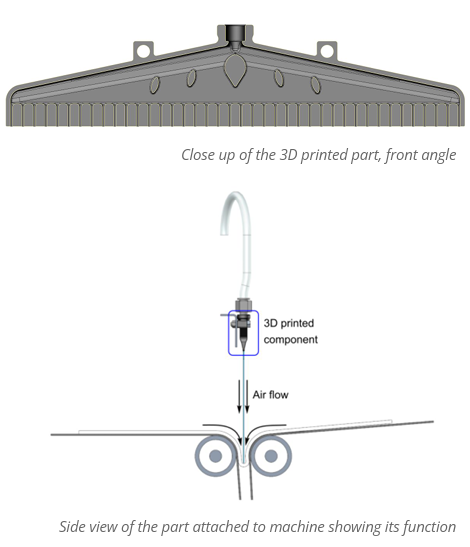
Optimizing internal geometry for better performances
With the optimization of the inner geometries of the part, the quantity of pressured air required to fulfill its function was reduced from 5,5 bars to 4 bars which resulted in lower air consumption and a more sustainable machine. The small channels created within the part to direct airflow significantly reduced the noise impact the machine makes. Previously with the basic drilled tube part, the airflow did not have a precise direction and the single tunnel echoed the sound of the air pressure.
Better design at a competitive price
During their additive design process, Girbau was able to design a part with complex geometries, integrated functional parts and lightweight and compact. The additive nature of 3D printing technology means that creating a complex part does not come at a higher price and in fact can be sometimes cheaper since less material is used. With these design possibilities, Girbau was able to create a single solution part that was cost-effective. This would not have been possible with traditional manufacturing methods since the design possibilities for traditional manufacturing require expensive molds and large production volumes to make up for the cost.
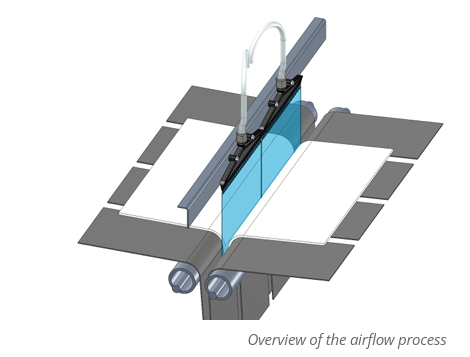
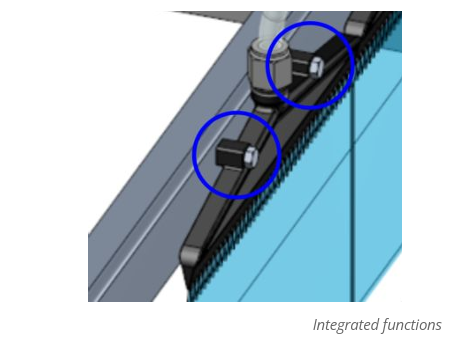
Making the most of integrated functions
The simplification of their part which now had integrated functions such as supports that made it possible to easily attach their part to a rack within the folding machine. A more compact model that would not be possible to find in the market or challenging to create with traditional manufacturing methods.
Ultracur3D® EPD 1086 : The precision needed to meet manufacturing challenges

Girbau was advised to use LCD (Liquid Crystal Display) printing technology to create tiny channels within the part, which powder technology cannot do, using the resin material EPD 1086.
Ultracur3D® EPD 1086 is a resin for 3D printing, developed by Photocentric technology and belonging to the photopolymer materials Engineering Plastic Daylight (EPD) line. This is a photosensitive resin. This resin is suitable for many applications and is particularly useful for manufacturing large parts, with a platform measuring 510 mm x 280 mm. The Ultracur3D® EPD 1086 offers the ability to create high-quality components for demanding applications and industries at a competitive price.
What They Say:

They trust us




Start Your 3D Printing Journey with Us Today
Professional 3D printing is at your fingertips. Create a free account and upload your 3D files, select your material, technology, and post-processing options, and order online. We’ll take care of the rest in our industrial ISO 9001 factory.