
3D Learning Hub
3D Learning Hub

Pull-out resistance of threaded inserts: Test and results

Key Takeaways

  • Pull-out resistance is the maximum axial force required to pull a threaded insert out of its plastic housing; it directly indicate how much load a bolted joint can safely carry.

  • We did a traction test at Sculpteo to measured pull-out resistance for heat‑set brass inserts from M2 to M6, in both short and long versions, embedded in MJF PA12 parts.

  • Larger diameters and longer inserts provide significantly higher pull-out resistance, with the strongest configurations reaching forces in the kilonewton range.

  • Inserts were installed using a temperature‑controlled soldering iron, reproducing real workshop conditions so the results are representative of customer applications.

Understanding Pull-Out Resistance in threaded inserts

Pull-out resistance is the axial tensile force needed to extract a threaded insert from the surrounding material along the screw axis. In real applications, this corresponds to cases where a screw is loaded in tension, such as hanging a component from a vertical wall, clamping parts that are pried apart, or attaching hardware to a panel under direct pull.

Unlike material tensile strength, which is an intrinsic property, pull-out resistance is a system metric that depends on the insert geometry, the plastic, the installation process, and the design of the printed boss around the insert. It is often the limiting factor in lightweight plastic designs: the metal insert and screw are usually stronger than the plastic that holds them, so failure occurs by the insert tearing out of the part.

Pull out resistance insert

Key factors influencing insert strength

Several parameters control how much load a threaded insert can resist before it pulls out:

Insert diameter and length

The size of the insert plays a major role in its holding power.

  • Larger diameters engage more of the surrounding plastic, spreading out the stress over a greater area. This reduces the likelihood of the material failing around the insert.

  • Longer inserts add more surface area in contact with the plastic, which also helps distribute the load more evenly.
    In practical terms, if you can afford the space, choosing an insert that is both longer and slightly larger will almost always result in better pull-out strength.

Knurling and exterior geometry

The outer design of the insert determines how well it mechanically locks into the plastic.

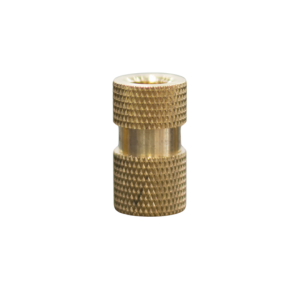
knurled insert
ribbed undercut insert
  • Knurling (small ridges or grooves) creates friction and allows molten plastic to flow into the gaps during installation, forming a strong bond once cooled.
  • Undercuts and helical ribs provide additional anchoring points, resisting rotational and tensile forces more effectively.
    In short, the more “texture” the insert has on its outside, the better it grips the printed part especially important for plastics that can deform slightly under heat or load.

Base material and print process

The 3D printing method and material properties directly affect insert performance.

  • In MJF PA12, for example, the material is relatively strong and has good layer cohesion compared to other printing processes. However, factors like print orientation, infill density, and local wall thickness will still influence how much load the part can carry.

  • If the layers are poorly fused (common in FDM printing) or the part has low density, the plastic around the insert can crack or deform more easily under stress.
    Optimizing print settings such as higher density, correct orientation, and adequate wall thickness can make a big difference in pull-out resistance.

Installation quality

Even with the right insert and material, poor installation can ruin performance.

  • The hole size must match the insert’s recommendation closely. If it’s too small, you risk cracking the plastic; too large, and the insert won’t grip properly.

  • Heating and alignment are also critical. A soldering iron or installation tip should melt the insert gently into the plastic without burning or displacing the surrounding layers.

  • Finally, ensure the insert goes in straight and flush, or the load may apply unevenly, leading to premature failure.

Test Objective

The study was launched to answer a recurring customer question: How much load can a threaded insert in a 3D printed part safely withstand in pull‑out? The objectives were:

  • To measure the maximum pull‑out force of heat‑set brass inserts from M2 to M6, in both short and long versions, installed in PA12 parts printed with MJF.

  • To define recommended design dimensions for insert housings (bore diameter, depth, external diameter and minimum wall thickness) that ensure robust performance.

Test Methodology Overview

Dedicated test specimens were designed with a single insert embedded in a reinforced boss, allowing the insert to be pulled in nearly pure tension. Parts were printed in PA12 using Multi Jet Fusion, which offers good dimensional accuracy and repeatable mechanical properties suitable for comparative testing.

The pull‑out tests were carried out on a Zwick/Roell Z005 universal testing machine, configured similarly to standard tensile tests but adapted to measure insert extraction forces. A fixed distance between fixtures and a controlled crosshead motion were used while the machine recorded force versus displacement, and the software was set to report the maximum force directly in newtons rather than converting to stress.

 For each insert configuration (diameter and length), five specimens were tested to capture variability and compute an average pull‑out force along with minimum and maximum values.

Pull out insert resistance machine

Installation Technique

To reproduce realistic workshop conditions, the brass inserts were installed with a temperature‑controlled soldering iron, also known as a heat‑set method for threaded inserts.

Insert installation
  • Pilot holes were integrated in the printed specimens with diameters and depths defined in the design table, ensuring a snug fit once the plastic melted and re‑solidified around the insert.
  • Heating and positioning involved placing the insert at the entrance of the pilot hole and pressing it gently with the heated soldering iron tip until the surrounding PA12 softened.

  • Insertion continued slowly until the insert was fully seated and flush with the surface, maintaining perpendicular alignment so that the internal thread remained coaxial with the hole.

  • Cooling allowed the molten plastic to solidify again, locking the knurled exterior of the insert into the PA12 and creating a strong mechanical bond representative of normal user practice.

Pull-out Resistance Results

The main results are presented in a one‑page table that links each insert size to its recommended housing dimensions and measured pull‑out resistance. This makes it easy to go from a design requirement to a specific insert size and bore geometry.

Pull-out resistance and housing dimensions

Insert size Bore Ø D [mm] Bore depth L [mm] External Ø A [mm] Min. wall B [mm] Pull‑out resistance [N]
M2 (short) 3.3 3.18 7.16 5.51 477
M2 (long) 3.3 3.99 7.26 5.61 572
M2.5 4.1 3.56 9.50 7.45 825
M3 (short) 4.1 3.56 9.24 7.19 813
M3 (long) 4.1 5.74 9.50 7.45 1 258
M4 5.7 4.70 12.76 9.91 1 372
M5 6.5 6.35 14.32 11.07 > 1 800
M6 8.1 7.92 17.52 13.47 > 1 800

These values show several clear trends:

  • Increasing diameter increases strength: pull‑out resistance rises from 477 N for an M2‑short insert to more than 1 800 N for M5 and M6 inserts when installed with the recommended housing geometry.

  • Longer inserts are stronger: for M2 and especially M3, the long version provides significantly higher pull‑out resistance than the short version, confirming that extra embedded length gives the plastic more area to grip.

  • Wall thickness is essential: the recommended minimum wall thickness around the bore, given by B=(AD)/2, ensures the plastic boss does not split before the insert reaches its pull‑out limit.

In all cases, failure occurred by the insert being pulled out of the PA12 once the load reached the listed value, rather than by thread stripping or screw fracture, meaning these numbers are directly relevant to joint design.

How to use these results in your designs

The table can be used as a fast sizing tool when designing 3D printed parts that incorporate threaded inserts.

  1. Estimate the maximum service load
    Determine the highest tensile load the screw–insert assembly will see, including static weight, shock, and dynamic effects such as vibration.

  2. Choose a safety factor
    For non‑critical applications, a factor of 2–3 on pull‑out resistance is common; for structural or safety‑critical parts, factors of 3–5 or higher are recommended to cover material variability, ageing, and installation tolerances.

  3. Select insert size and length

    • Look up the pull‑out resistance in the table and divide it by your safety factor to obtain an approximate allowable working load per insert.

    • For example, an M3‑long insert offers 1 258 N; with a safety factor of 3, the recommended working load is about 420 N in pure tension per insert.

    • If this value is too low for your application, move to a larger insert (M4–M6), choose the long version instead of the short one, or use multiple inserts to share the load.

  4. Design the boss and housing

    Use the bore diameter D and depth L from the table in your CAD model to ensure correct fit

    Maintain at least the minimum wall thickness B around the bore; thicker walls can further reduce the risk of cracking, especially in impact‑loaded or thin‑walled regions.​​

    Incorporate generous fillets and avoid placing inserts too close to edges or corners to minimise stress concentrations.​

  5. Match installation conditions

    • Use a temperature‑controlled soldering iron and install the inserts until they are flush, as done in the tests, to stay close to the validated configuration.

    • Avoid overheating, which can degrade the plastic, and verify alignment to prevent bending loads on the insert that were not present in the test setup.

  6. Validate for demanding applications
    For high‑stakes designs, consider running a small number of pull‑out tests on representative parts to confirm that your specific geometry, print orientation, and environment reproduce or exceed the tabulated performance

Not sure which insert fits your project?
Our experts can recommend the best option for your material, load, and design !​

Conclusion

Pull‑out resistance of threaded inserts is a key design parameter for durable, serviceable 3D printed assemblies, especially when screws are loaded in tension rather than shear. Sculpteo’s test campaign on heat‑set brass inserts in MJF PA12 quantifies how diameter, length and housing geometry influence pull‑out resistance, with measured forces ranging from a few hundred newtons for compact M2 inserts up to more than 1 800 N for M5 and M6 sizes. By following the recommended bore dimensions, respecting minimum wall thicknesses, and applying appropriate safety factors, designers can confidently integrate threaded inserts in their printed parts and ensure that the joint will withstand real‑world loads with a comfortable margin.

People Also Ask

Get the latest 3D printing news delivered right to your inbox

Subscribe to our newsletter to hear about the latest 3D printing technologies, applications, materials, and software.