
3D Learning Hub
3D Learning Hub

Tensile Stress 101: Your essential Guide to understanding material tension

Have you ever wondered why some materials snap under pressure while others stretch and bend with ease? The answer lies in the concept known as tensile stress. This pivotal principle in materials science and engineering determines how materials behave under tension, influencing everything from the bridges we drive over to the skyscrapers that define our city skylines. Understanding this key concept helps differentiate between a successful design and a catastrophic failure. Let’s explore the intricacies of tensile stress and discover its impact. 

Key Takeaways

  • Tensile stress measures the stretching force a material can withstand before breaking

  • The formula for calculating tensile stress involves dividing tensile force by the cross-sectional area

  • Distinguishing between tensile stress, tensile strength, and yield strength is crucial for engineers

  • Tensile stress in additive manufacturing

What is Tensile Stress? A simple definition

Tensile stress is a fundamental concept in materials science that describes how much force a material can withstand when being stretched or pulled. It’s like the silent referee on the sidelines, keeping tabs on how materials behave when faced with tension. Engineers define tensile stress as the force applied per unit area also known as normal stress and it’s crucial for predicting how materials will perform under load conditions.

When you apply a force to stretch a material, tensile stress comes into play. It measures the internal forces acting within the material, offering insights into whether it will hold firm or give way. Imagine pulling on a rubber band; tensile stress gauges how much tension the band can handle before snapping. This property is essential in designing structures and products that must endure forces without breaking.

Tensile tests, often conducted using universal testing machines, allow engineers to measure the ultimate tensile strength of materials. These tests reveal how materials behave under tension, providing valuable data for engineering applications. By calculating tensile stress, engineers can determine a material’s capacity to bear loads, guiding decisions in product design and material selection.

Tensile stress illustration

In engineering terms, tensile stress is often paired with its counterpart, strain. While stress measures the force per unit area, strain quantifies the deformation or elongation of the material. Together, they provide a comprehensive picture of how materials respond to tension, guiding decisions in material selection and engineering design.

Understanding Strain: The companion to Tensile Stress

While tensile stress measures the force applied to a material, tensile strain tells us how the material responds. Strain is the deformation or elongation a material undergoes when subjected to stress essentially, how much it stretches. It’s a dimensionless ratio calculated by dividing the change in length by the original length of the material.

Understanding strain is essential for a complete picture of material behavior. For example, two materials might experience the same tensile stress but exhibit very different strains one might barely stretch, while the other elongates significantly. This difference is critical when selecting materials for applications that require flexibility, elasticity, or resistance to deformation.

Strain is often categorized as elastic strain, where the material returns to its original shape after the force is removed, or plastic deformation, where the deformation is permanent. 

In combination with tensile stress, strain provides engineers with the data needed to predict failures, fine-tune designs, and ensure material performance under real-world loads.

How to calculate Tensile Stress: The formula explained

Grasping the calculation of tensile stress is like having the key to unlock material behavior under tension. With a simple formula, you can quantify how much stress a material experiences when subjected to a stretching force. This understanding is vital for designing structures that can withstand real-world forces without failing.

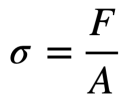
The formula for tensile stress is relatively straightforward : divide the tensile force by the cross-sectional area of the material. Expressed in Pascals (Pa), this unit of measurement allows engineers to compare and analyze materials effectively. Accurate measurements of both force and area are crucial to ensure reliable calculations, as even slight errors can lead to significant design flaws.

Recognizing the importance of tensile stress calculations helps you appreciate the meticulous work that goes into engineering safe and efficient structures. 

stress formula
Stress Formula

σ is stress, measured in N/m² or Pa

F is the applied force, measured in Newtons (N)

A is the cross-sectional area to which the force is applied, measured in m²

Tensile Stress vs. Tensile Strength vs. Yield Strength: Clearing the confusion

Terms like tensile stressultimate tensile strength, and yield strength often get tossed around, sometimes creating a tangled web of confusion. Distinguishing between these terms is essential for engineers to design structures that stand the test of time.

Property Tensile Stress Tensile Strength Yield Strength
Definition The internal force per unit area within a material when subjected to tension The maximum tensile stress a material can withstand before failure The stress level at which a material begins to deform plastically
Measured during Any stage of loading At the breaking point during a tensile test At the onset of permanent (plastic) deformation
Indicates Current stress in a material under load Ultimate capacity before fracture Limit of elastic behavior (end of reversible deformation)
Units Pascals (Pa), N/m² Pascals (Pa), N/m² Pascals (Pa), N/m²
Importance in design Helps monitor stress levels during use Helps select materials based on their ultimate limits Helps prevent permanent deformation in safety-critical designs
Example use Real-time load analysis in structures Comparing material strength (e.g., steel vs. aluminum) Determining safe loading conditions in structural components

Tensile strength indicates the maximum stress a material can handle before breaking. It’s the benchmark for understanding a material’s ultimate capacity under tension. On the other hand, yield strength defines the stress level at which a material begins to deform permanently. This is the point where the material transitions from elastic to plastic behavior, no longer returning to its original shape after the force is removed.

Tensile stress, however, describes the stress experienced by a material at any given point under tension. Unlike tensile strength, which measures the breaking point, tensile stress provides insights into the material’s behavior throughout the loading process. This distinction is crucial for engineers to prevent design failures and ensure the longevity of structures.

Tensile Stress considerations in Manufacturing (Including 3D Printing)

Manufacturing techniques must account for tensile stress to ensure product quality and performance. From traditional methods to cutting-edge technologies like 3D printing, understanding tensile stress is crucial for developing reliable products.

3D printing offers precise control over a material’s tensile properties, allowing manufacturers to create complex structures with tailored stress resistance. This technology enables the production of lightweight yet strong components, ideal for industries like aerospace and automotive.

The choice of raw materials impacts the tensile stress outcomes in manufacturing. Selecting popular Sculpteo materials such as Nylon PA12, Ultrasint® PA11, and reinforced PA12 composites enables manufacturers to balance cost, performance, and durability.

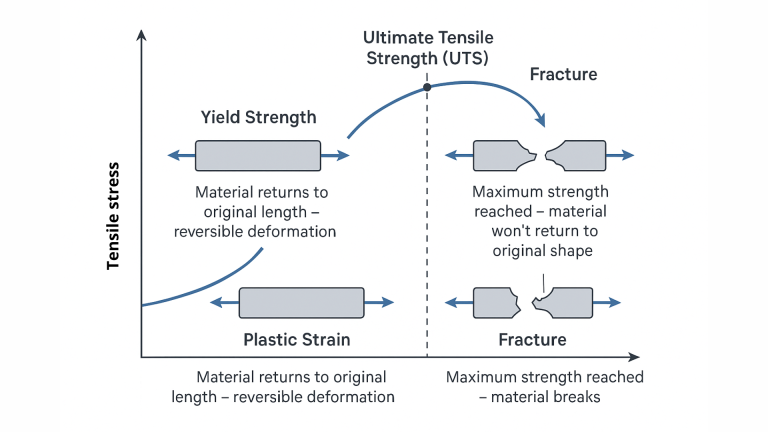
Tensile test illustration

Manufacturers often test tensile stress to improve product performance and longevity. By analyzing how materials respond to tension often through the engineering stress-strain curve they can identify potential weaknesses and make necessary adjustments to enhance reliability.

Understanding stress and strain in manufacturing leads to better product design and innovation, driving advancements in technology and improving the quality of everyday items.

Frequently Asked Questions

Get the latest 3D printing news delivered right to your inbox

Subscribe to our newsletter to hear about the latest 3D printing technologies, applications, materials, and software.