
3D Learning Hub

3D Printed Anatomical Models: Revolutionizing modern medicine

Key Takeaways

  • 3D printed anatomical models are transforming surgery, education, and patient care.

  • Additive manufacturing delivers specific replicas of bones, organs, and vessels.

  • Accessible segmentation tools play a crucial role in converting scans into printable models.

  • Hospitals, universities, and medical device manufacturers benefit from personalized, precise solutions.

3D printed anatomical models are no longer just prototypes or educational tools; they are becoming central to patient care, medical training, and innovation in healthcare. Thanks to the precision of additive manufacturing, doctors and researchers now have access to replicas of organs, bones, and tissues. 

What is a 3D printed anatomical model and why is it essential?

A 3D printed anatomical model is a highly accurate physical reproduction of a patient’s anatomy, created from medical imaging such as CT (Computed Tomography) scans, MRI (Magnetic Resonance Imaging), or even ultrasound scans. Unlike traditional plastic models, these replicas are personalized, reflecting the exact shape, size, and pathology of an individual organ or structure.

Anatomic modele illustration

The benefits are significant:

  • Surgeons can rehearse complex interventions before entering the operating room.

  • Students and medical teams can study detailed human anatomy models without relying on cadavers.

  • Patients gain a clearer understanding of their condition when doctors use realistic models for communication.

This combination of personalization, precision, and accessibility explains why 3D anatomy models are rapidly becoming an essential part of modern healthcare. Whether it’s skeleton models, vascular models, or full-scale skull replicas, these resources are making a profound impact.

From patient scan to printed model: The creation process

Producing a medical model requires a careful workflow that blends imaging, digital modeling, and advanced manufacturing.

Data Acquisition and Segmentation

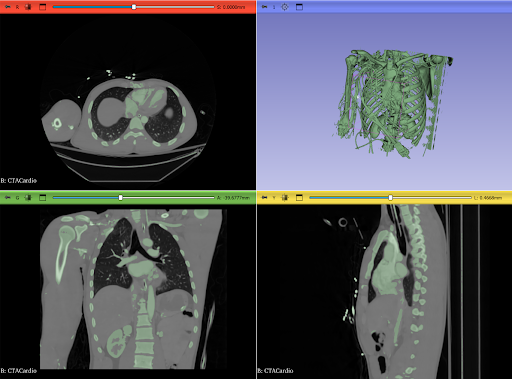
The process begins with medical scans in DICOM format. Specialized software segments these scans, isolating specific structures such as a heart valve, liver tumor, or blood vessels into a usable 3D file. This step ensures that the printed model is faithful to the patient’s real anatomy.

Segment anatomic modele

Software and File Formats

Once segmented, the 3D data is converted into printable formats such as STL or OBJ. These digital 3D objects can be edited, scaled, or optimized depending on the medical use case. At Sculpteo, you can transform scans into files suitable for prototyping.

Anatomic scans to 3D file

Printing and Post-Processing

The 3D file is then sent to production. Depending on the requirements, we use technologies such as Selective Laser Sintering (SLS), Multi Jet Fusion (MJF), for highly detailed parts. Post-processing such as smoothing, coloring, or transparency finishes can make models look and feel closer to real specimens.

prototype du-squelette du pied humain impression 3D

Segmentation Tools: From Imaging to Anatomical Models

An essential step in creating accurate anatomy models is segmentation, which is the process of turning raw scans into usable files. Among the leading solutions, Slicer 3D stands out for its ability to transform complex CT and MRI data into printable models.

This open-source segmentation software allows medical professionals to isolate structures with precision, generate detailed 3D visualizations, and prepare files for printing. Its role is crucial: without proper segmentation, even the most advanced printers cannot produce accurate human anatomy models.

We did a test at sculpteo shown bellow :

Sculpteo 3D Printed anatomic model from Slicer 3D

Curious to dive deeper? We’ve published a dedicated article about segmentation software and the impact of Slicer 3D on modern medicine

Advanced 3D printing technologies and materials

The success of a 3D printed anatomical model depends on the right choice of technology from 3d printers and material.

Key Printing Technologies

  • Selective Laser Sintering: Powder bed technologies offer a wide variety of materials such as Nylon PA12 are a perfect option to prototype surgical tools or orthotics for example.
  • Multi Jet FusionUltrasint® TPU01PA11 or  PA12 provides high precision and surface detail, suitable for complex vascular models and organ replicas.
  • Stereolithography (SLA): Offers excellent surface quality and transparency, making it ideal for models that need internal visibility, such as cardiac structures.

Biocompatible and Specialized Materials

Medical applications demand more than standard plastics. At Sculpteo, we offer:

  • TPU (Thermoplastic Polyurethane): Ideal for creating soft models, TPU offers excellent flexibility and durability. It is perfect for simulating tissues and other anatomical structures that require a certain degree of elasticity.
  • PA11 (Polyamide 11) or PA12 (Polyamide 12): These materials are well-suited for creating hard models. Both PA11 and PA12 provide high strength and stiffness, making them excellent choices for printing bones or other rigid anatomical structures. Additionally, PA11 is known for its superior impact resistance and ductility, while PA12 offers good resistance to chemicals and moisture. Another option in the same family, is PA12 S known for its smooth surface finish. 
  • Ultrasint® PA11: A biocompatible, skin-safe material well-suited for surgical guides.

  • Prototyping resin:  If you are looking for a resin with a great accuracy to create prototypes, this might be a great option to consider.

These material choices allow healthcare professionals to select models that not only look realistic but also mimic the tactile response of real human anatomy.

    Revolutionary applications in healthcare

    3D printed anatomical models are transforming multiple areas of medicine, offering benefits far beyond visualization.

    equipement chirurgical

    Advanced Surgical Planning and Training

    Surgeons can practice procedures on patient-specific 3D models, reducing risks and shortening surgery time. For example, a complex kidney transplant can be rehearsed on a 3D replica before operating on the patient.

    examinant un modele-anatomique

    Improved Diagnostics and Patient Communication

    Doctors can explain conditions more clearly using a tangible model. Patients often feel reassured when they can see and touch a replica of their own anatomy, improving understanding and trust.

    Wrist orthèse

    Customized Medical Devices and Instruments

    From surgical guides to prosthetic devices, 3D printing enables tools that are tailored to each patient’s morphology. At Sculpteo, we have supported medical professionals in developing innovative surgical instruments adapted to different cases.

    Modele anatomique du coeur a des fins educatives

    Case Studies: Gynecology and Cardiology

    3D printed uterine models have helped gynecologists plan complex surgeries, while cardiologists use printed heart structures to simulate stent placements or bypass operations. These twins of patient anatomy serve as perfect rehearsal tools for delicate procedures.

    Real-World Innovation:

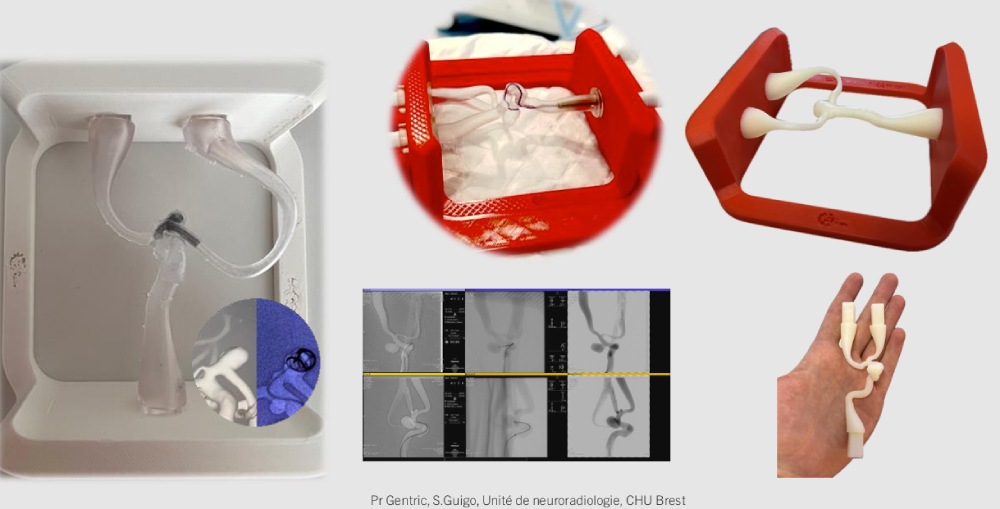
    Another inspiring example of innovation in medical 3D printing comes from Samuel Guigo, a radiologic technologist at the University Hospital of Brest. As one of the key figures behind W.print, a hospital-based 3D printing unit, he works closely with surgeons and engineers to design patient-specific anatomical models and custom medical devices. His work demonstrates how hospitals can leverage segmentation tools and additive manufacturing to directly improve patient care and daily medical practice.

    Educational uses: Anatomy series and medical simulators

    3D printed models are not only for surgery they also improve teaching and training. Medical schools now use anatomy series collections to replace traditional teaching kits. These sets include skeleton models, skulls, and organ replicas, often developed from radiological data or cadaver studies.

    In addition, medical simulators built with additive manufacturing allow repeated practice of procedures such as biopsies, catheter insertions, or tumor resections. Because they are reusable and customizable, these models reduce costs while providing authentic haptic feedback. Health Organizations have demonstrated how these tools accelerate learning and standardize medical education worldwide.

    Medecin tenant un squelette modèle anatomique

    Choosing the right 3D Printing partner for medical projects

    Not all 3D printing services are suited for the demanding needs of healthcare. Quality, precision, and material certification are essential.

    At Sculpteo, we bring:

    Whether you need a single organ replica for training or a complete set of anatomical parts for clinical trials, we adapt to your project’s scale and complexity.

    Challenges and future perspectives

    While medical device prototyping are already revolutionizing medicine, 3D printed anatomical models challenges remain. Medical device manufacturers must navigate strict regulatory frameworks to ensure safety. Bioprinting using living cells to print tissues and organs shows promise but is still in early stages.

    Still, the future is bright. Hospitals worldwide are investing in anatomic modeling units to integrate this technology into daily practice. As materials evolve and printers become faster, 3D printed anatomical models will expand beyond planning and training into regenerative medicine, personalized implants, and even organ transplantation.

    Conclusion: A 3D Printed future for medicine

    3D printed anatomical models are redefining modern healthcare, bridging the gap between digital data and real-world applications. They empower surgeons to plan with confidence, help students learn with unmatched realism, and give patients a new way to understand their treatments.

    At Sculpteo, we are proud to support this medical revolution by offering cutting-edge 3D printing services, advanced materials, and dedicated expertise. The future of medicine is being built layer by layer and it starts with medical 3D printing.

    People Also Ask

    What are 3D printed anatomical models used for?

    3D printed anatomical models are used for surgical planning, medical training, patient education, and developing custom medical devices

      How does medical 3D printing improve surgery?

      Medical 3D printing creates patient-specific models, allowing surgeons to rehearse complex procedures, reduce risks, and save time in the operating room

      Why are anatomy models important in medical education?

      Anatomy models help students study human anatomy in detail, replacing cadavers with reusable, realistic models that improve hands-on learning.

      What technologies are best for 3D anatomy models?

      Technologies like MJF, SLS, and SLA provide high accuracy

      Can hospitals use 3D printing directly?

      Yes, many hospitals now have anatomic modeling units that create specific 3D anatomy replicas for training, diagnostics, and patient care

      Get the latest 3D printing news delivered right to your inbox

      Subscribe to our newsletter to hear about the latest 3D printing technologies, applications, materials, and software.