
Login
If you have any trouble logging in to your account, contact us.
Sign Up
To start 3D printing or Laser Cutting, you'll need to create an account here. Once done, you'll be able to upload your files and get live quotes of yours parts
Already have an account? Log In
Home » 3D printing by industries » 3D Printed Prostheses: Innovation at the service of medical industrie
3D printing is transforming prosthetics, making devices more affordable, customizable, and accessible worldwide.
Prosthetic limbs such as hands, forearms, and arms can now be produced faster with rapid prototyping and digital workflows.
Certified materials like PA12 ensure durability, comfort, and safety for artificial limbs and medical applications.
3D printing is transforming the medical field, and innovations such as orthotic insoles, 3D printed orthoses, prosthetics, and even 3D printing prosthetics accessories for animals are part of this growing revolution. From 3D printed casts to highly personalized orthopedic and prosthetic solutions, additive manufacturing is reshaping the way care is delivered. Once considered expensive, time-consuming, and inaccessible for many patients, orthoses and prosthetic devices are now entering a new era of customization, speed, and affordability thanks to 3D printing technologies. In this article, we’ll explore the advantages, workflows, technologies, and real-world applications of 3D printed orthoses and prostheses, including solutions designed for both humans and animals, and how companies like Sculpteo support professionals in bringing these innovations to life.
One of the greatest strengths of 3D printed prostheses is mass customization. Each patient has unique anatomy, and traditional manufacturing often struggles to adapt devices at scale. Additive manufacturing enables the creation of tailor-made prosthetic limbs that fit perfectly, improving comfort and functionality.
Another advantage is cost reduction. Traditional prosthetics can be prohibitively expensive, especially in developing countries. With 3D printers, it’s possible to design high-quality devices at a fraction of the cost, without compromising on safety or performance.
Digital workflows drastically reduce lead times, allowing patients including every amputee to receive functional devices much faster. This is particularly valuable for children, whose needs change as they grow.
The creation of a 3D printed prosthesis begins with data acquisition, often through medical imaging or 3D scanning of the patient’s limb. This ensures precision from the start.
Next comes digital design. Engineers and clinicians collaborate using CAD software to create a 3D model that matches both the patient’s anatomy and their functional requirements.
Once the design is validated, it is sent to production using a printer with technologies such as Selective Laser Sintering (SLS) or HP Multi Jet Fusion (MJF). Post-processing such as smoothing or surface finishing ensures the prosthesis is safe, durable, and comfortable.
The final step is fitting and adjustment, often requiring far less manual work compared to traditional methods of producing prosthetic sockets.
Different 3D printing technologies offer unique benefits for prosthetic design:
SLS (Selective Laser Sintering): Excellent for producing multiple customized prostheses quickly, with high precision and repeatability.
MJF (Multi Jet Fusion): Ideal for durable, lightweight parts. Widely used with Nylon PA12 S, which combines strength, flexibility, and biocompatibility.
At Sculpteo, we offer 75+ materials and finishes, including biocompatible nylons, composites, and finishing option, giving healthcare professionals the freedom to choose the most suitable option for their patients and their medical applications.
Examples of 3D printed prostheses highlight both practicality and creativity:
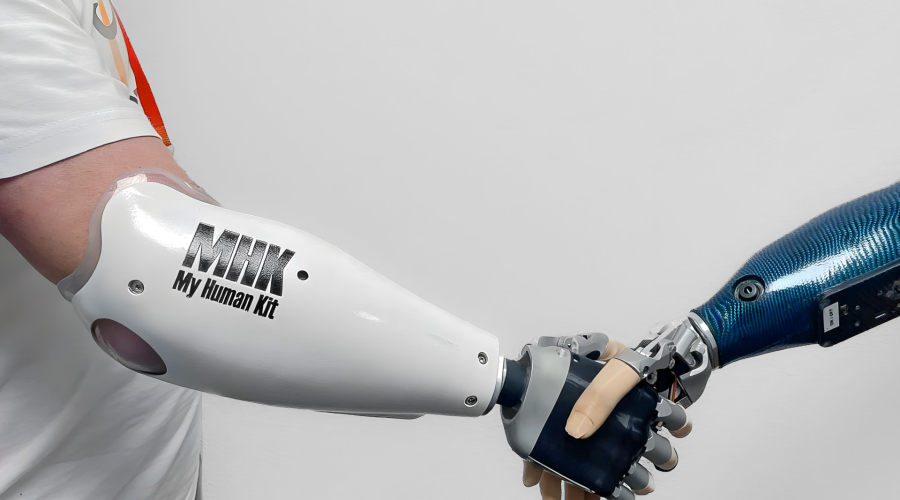
One inspiring example of how 3D printing is reshaping the field of prosthetics is the work of My Human Kit, a French non-profit based in Rennes. Dedicated to inclusive, open-source innovation, the organization develops prosthetic limbs, orthotics, and assistive devices designed with and for people with disabilities. By combining collaborative design, rapid prototyping, and industrial 3D printing technologies such as Multi Jet Fusion (MJF), My Human Kit creates solutions ranging from bionic hands to custom wheelchair accessories. Their approach not only makes advanced prosthetic devices more affordable but also empowers users to become active participants in the design process.
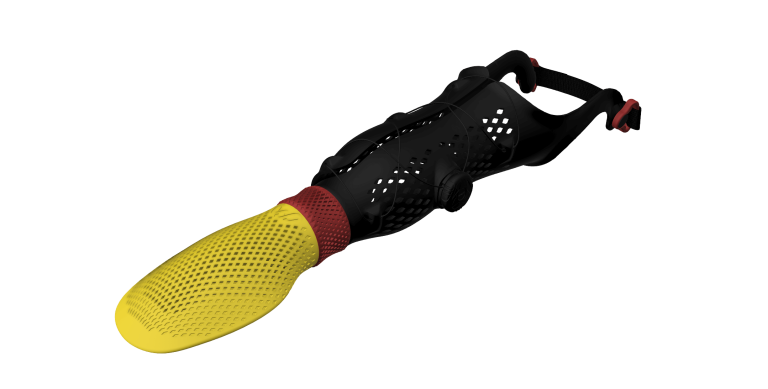
Another strong example of innovation in the field of prosthetics comes from Macu4, a Zurich-based start-up redefining how forearm prosthetics are designed and produced. Founded in 2021, the company leverages 3D printing, Selective Laser Sintering (SLS), and advanced materials like Nylon PA12 to create lightweight, modular devices that adapt to each patient’s lifestyle. Their flagship solution, the Explorer prosthetic system, features interchangeable “activity hands,” allowing users to switch between grips for sports, daily tasks, or leisure activities. By combining design automation with additive manufacturing, Macu4 not only reduces costs but also makes it easier to provide affordable, high-quality prostheses that grow with children and support an active and independent living.
These projects illustrate how additive manufacturing is not only about engineering but also about accessibility, inclusivity, and dignity in the field of prosthetics.
While the technology is powerful, success depends on the right partner. Prosthetic projects require rigorous quality control, advanced design expertise, and reliable production capacity.
At Sculpteo, we combine more than 10 years of expertise with industrial-grade equipment. Our ISO ISO 13485-certified site ensures repeatability, while our instant online quoting system makes it easy to move from idea to production in just a few clicks.
As with any medical device, 3D printed prostheses must comply with strict regulatory frameworks. Fortunately, additive manufacturing is increasingly recognized in medical standards, and certified materials ensure patient safety.
On the sustainability front, 3D printing uses only the material necessary to produce the part, minimizing waste compared to subtractive methods. Moreover, localized production reduces shipping and carbon footprint, which benefits both the patient and the environment.
For patients, the outcome is lower costs and better access to life-changing devices. This is essential in reducing the global inequality of access to prosthetic arms, hands, and forearms after amputations.
The future holds smart prostheses, combining 3D printing with sensors, electronics, and AI to provide advanced functionalities such as tactile feedback in the fingers of an artificial hand. Lightweight lattice structures will further improve comfort, while bio-printed tissues could one day merge with prosthetic frameworks for unprecedented integration.
The growing adoption of digital workflows will also lead to faster, more inclusive distribution models, ensuring that prostheses are available not only in advanced hospitals but also in remote areas where surgeries are harder to access.
3D printed prostheses represent more than just a technological advancement they embody a human-centered innovation. By combining customization, affordability, and speed, additive manufacturing is reshaping the future of prosthetic care worldwide.
Whether you are a healthcare provider, a researcher, or part of an NGO, choosing the right partner can make your vision a reality. At Sculpteo, we provide the expertise, materials, and technologies to bring your prosthetic projects to life.
Ready to get started? Upload your 3D file today and receive a free instant quote. Our team of experts is here to help you design and produce prosthetic solutions that truly make a difference.
3D printing is used to create custom prosthetic limbs quickly and affordably, tailored to each patient’s anatomy
Yes, when produced with certified materials and tested designs, 3D printed prosthetic arms meet safety and durability standards
They offer lower cost, faster production, and high customization compared to traditional manufacturing
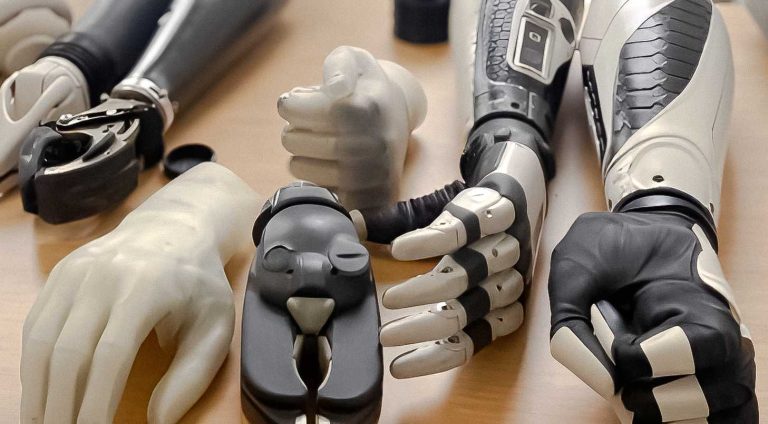
Yes, 3D printers can produce functional artificial hands, including myoelectric models with moving fingers
Depending on design and materials, you can get an instant quote on sculpteo.com just by uploading you 3D file
Get the latest 3D printing news delivered right to your inbox
Subscribe to our newsletter to hear about the latest 3D printing technologies, applications, materials, and software.
Connect with Google
Connect with Facebook