
Login
If you have any trouble logging in to your account, contact us.
Sign Up
To start 3D printing or Laser Cutting, you'll need to create an account here. Once done, you'll be able to upload your files and get live quotes of yours parts
Already have an account? Log In
Home » 3D printing by industries » 3D Printed arm prosthetic
3d printed arm prosthetics enable faster production and greater customization compared with traditional prosthetic manufacturing.
Digital workflows using 3D scanning and CAD design allow prosthetic sockets to be tailored to each patient.
Organizations such as My Human Kit demonstrate how collaborative innovation can accelerate prosthetic development.
Advanced prosthetic devices often rely on myoelectric control systems that convert muscle signals into motorized movement.
Engineering materials such as Nylon 12 (PA12) provide the durability and flexibility required for prosthetic components.
Industrial technologies like SLS and HP Multi Jet Fusion produce reliable parts suitable for everyday prosthetic use.
Industrial partners such as Sculpteo support prosthetic developers by manufacturing high-quality medical components at scale.
Upper-limb prosthetics have historically been expensive and difficult to manufacture. Traditional prosthetic arms can cost $20,000 or more, making advanced devices inaccessible to many patients around the world. In recent years, however, additive manufacturing has begun transforming this landscape. The emergence of the 3d printed arm prosthetic has introduced a faster, more customizable, and often more affordable approach to prosthetic development.
Instead of relying on standardized molds and complex manual fabrication, prosthetists and engineers can now use digital workflows. With tools such as 3D scanning, CAD design, and additive manufacturing, prosthetic components can be designed specifically for the anatomy and needs of each patient.
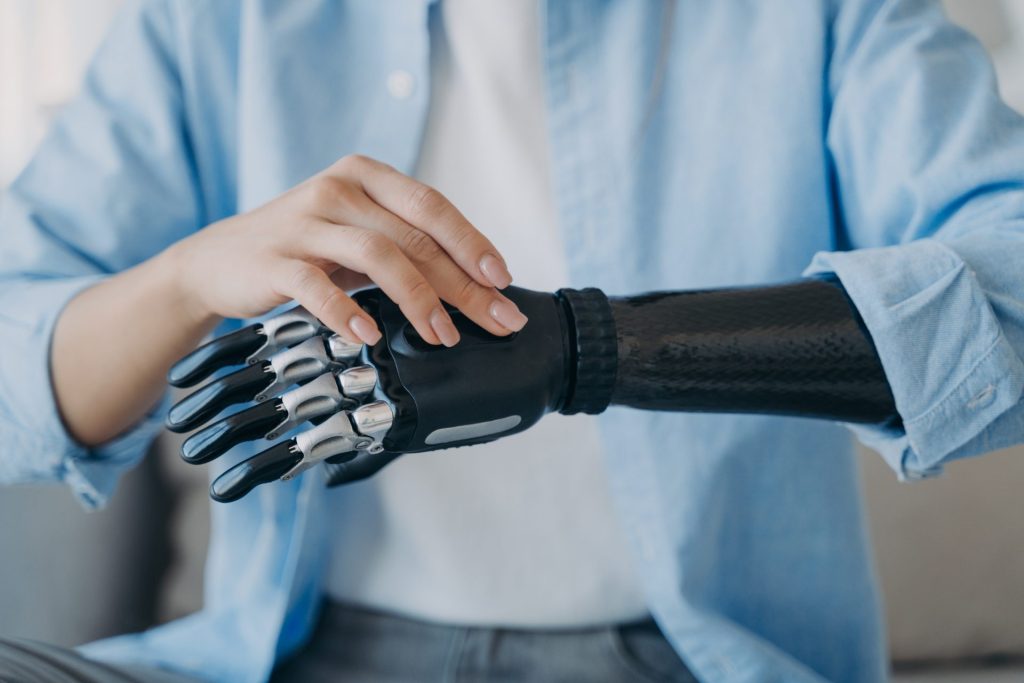
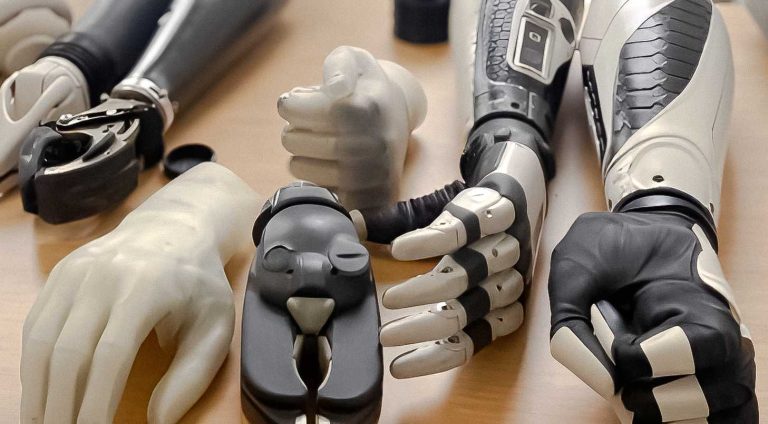
Today, 3D printing supports the creation of sophisticated bionic arm prosthetics that combine lightweight structures, electronic sensors, and customizable aesthetics. Industrial additive manufacturing has made it possible to produce prosthetic parts that are durable enough for daily use while maintaining design flexibility.
Companies and innovation labs developing these technologies often rely on manufacturing partners capable of producing high-quality parts at scale. Through its industrial technologies and engineering materials, Sculpteo supports the production of advanced prosthetic components and custom medical devices using professional additive manufacturing processes.
The concept of a 3d printed arm prosthetic initially emerged from research and experimentation within the maker and engineering communities. Early prototypes demonstrated how additive manufacturing could dramatically simplify the production of prosthetic devices.
Instead of creating physical molds or manually fabricating components, engineers could design prosthetic hands digitally and produce them directly from a 3D model. This approach significantly reduced manufacturing time and allowed prosthetic designs to be modified quickly.
The introduction of digital prosthetic design workflows also enabled a new level of customization. By capturing the shape of the residual limb using 3D scanning, prosthetists could design prosthetic sockets tailored precisely to the individual user.
While early experiments revealed the potential of additive manufacturing, they also highlighted the importance of materials and production methods. Many early designs relied on basic thermoplastics printed on desktop machines, which often lacked the durability required for everyday use.
These early innovations nonetheless laid the foundation for the modern generation of 3D printed prosthetic arms, demonstrating how digital manufacturing could transform prosthetic design.
As additive manufacturing technologies matured, organizations around the world began exploring how 3D printing could support more advanced prosthetic solutions.
One example is My Human Kit, an open innovation laboratory focused on developing accessible assistive technologies. The organization brings together engineers, designers, and individuals with disabilities to collaboratively develop prosthetic and assistive devices using digital fabrication tools.
Projects developed within the My Human Kit ecosystem illustrate how 3d printed arm prosthetics can combine mechanical components, electronics, and ergonomic socket design. Their collaborative approach allows users to actively participate in the design of their own assistive technologies, improving both functionality and personal ownership of the device.
Digital fabrication technologies such as 3D scanning, parametric modeling, and additive manufacturing allow prosthetic designs to be iterated rapidly. This enables researchers and designers to explore new ergonomic solutions and develop devices that better adapt to real-world needs.
However, moving from prototype to reliable device requires durable materials and professional manufacturing processes. Engineering polymers such as Nylon 12 (PA12) commonly used in industrial additive manufacturing, provide the mechanical strength and flexibility required for prosthetic components exposed to repeated daily stress.
By combining collaborative design initiatives like My Human Kit with industrial production capabilities, organizations can transform innovative prosthetic concepts into robust, real-world assistive devices.
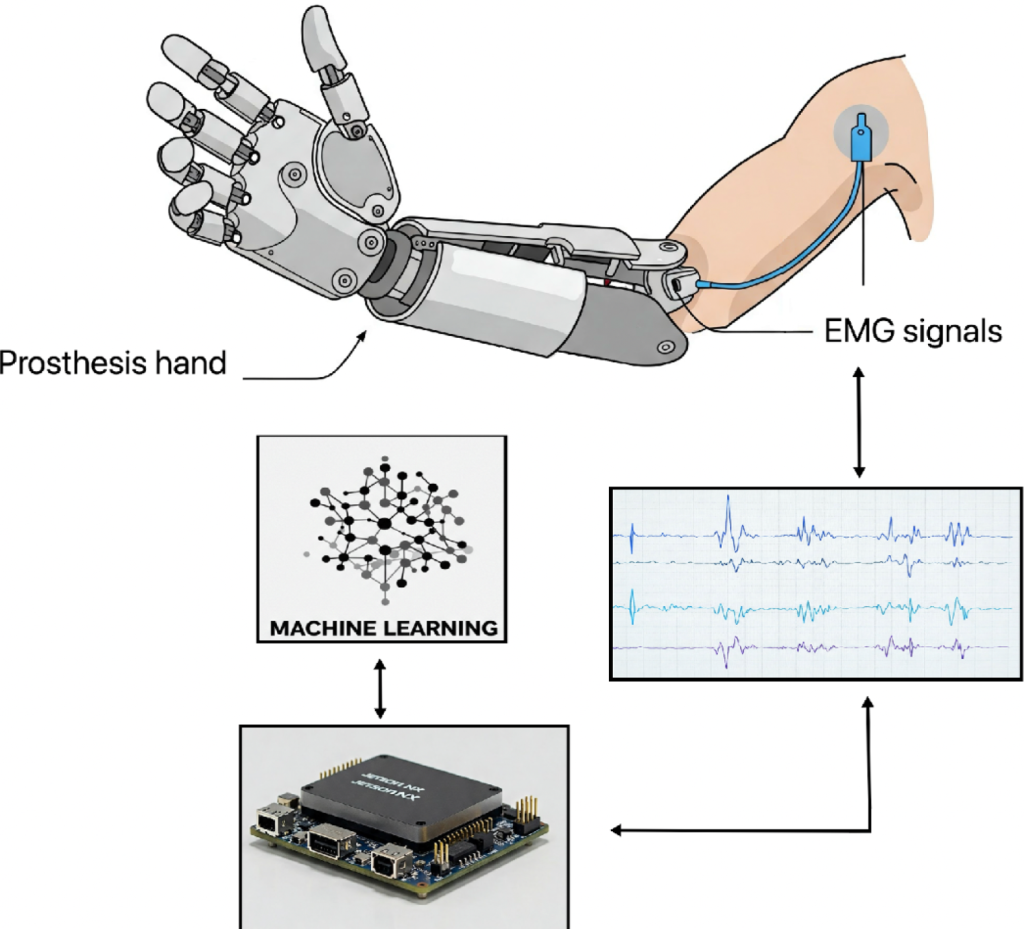
Many advanced bionic arm prosthetics rely on myoelectric control systems. These systems allow users to operate the prosthetic limb using electrical signals generated by their muscles.
When muscles in the residual limb contract, they produce small electrical signals that can be detected by electromyography (EMG) sensors. These sensors are typically embedded within the custom prosthetic socket, positioned carefully against the user’s skin.
The detected signals are transmitted to a microcontroller inside the prosthetic device. The controller interprets the signals and activates electric motors that move the prosthetic fingers or wrist. This allows users to perform a variety of grip patterns and daily tasks.
3D printing plays an important role in enabling these systems. The prosthetic structure must integrate sensors, motors, batteries, and structural components within a lightweight and ergonomic housing. Additive manufacturing allows engineers to create complex internal geometries and customized sockets that ensure sensors remain positioned correctly against the skin.
Although early prosthetic prototypes demonstrated the potential of additive manufacturing, professional prosthetic devices require industrial-grade manufacturing technologies.
Desktop filament printers can produce useful prototypes but often create parts with inconsistent mechanical strength. Because these printers deposit melted plastic layer by layer, the final parts may have weaker bonding between layers.
Industrial technologies such as Selective Laser Sintering (SLS) and HP Multi Jet Fusion (MJF) produce parts from powdered materials fused using laser or thermal energy. This process creates components with isotropic mechanical properties, meaning the strength of the material is consistent in all directions.
Materials also play a crucial role. Nylon 12 (PA12) is widely used in professional prosthetic manufacturing because it combines strength, flexibility, and lightweight performance. These properties allow prosthetic housings and structural components to withstand repeated daily use.
Industrial additive manufacturing also enables complex designs that improve comfort and usability. Engineers can create ventilated or lattice-structured prosthetic sockets that improve airflow while maintaining strength.
Through its medical 3D printing services, Sculpteo provides prosthetic developers with access to industrial additive manufacturing technologies capable of producing durable components suitable for advanced prosthetic devices. Learn more about Sculpteo’s medical 3D printing services.
| Feature | Traditional Prosthetic Arm | 3D Printed Arm Prosthetic |
| Manufacturing method | Manual fabrication and machining | Additive manufacturing (SLS / MJF) |
| Customization | Limited manual adjustments | Fully customized using 3D scanning and CAD |
| Production speed | Several weeks or months | Days to weeks |
| Weight | Often heavier due to solid materials | Lightweight optimized geometries |
| Design flexibility | Limited by molds and tooling | Complex shapes and personalized covers |
| Materials | Laminated composites and metals | Engineering polymers such as PA12 |
Additive manufacturing has opened the door to a new generation of prosthetic devices that combine functionality, customization, and efficient production workflows.
By eliminating expensive molds and enabling rapid design iteration, 3D printing allows engineers to refine prosthetic devices quickly. Custom components such as prosthetic sockets can be adapted to the anatomy of each patient while maintaining a lightweight structure.
Industrial manufacturing partners play a key role in scaling these innovations. With professional additive manufacturing technologies, startups, research labs, and prosthetic clinics can transform experimental designs into reliable medical components produced at industrial quality standards. To explore how additive manufacturing is advancing prosthetic design, visit Sculpteo’s page on 3D printed prostheses.
The evolution of the 3d printed arm prosthetic illustrates how additive manufacturing is transforming the prosthetics industry. What began as experimental digital designs has evolved into a sophisticated ecosystem of advanced prosthetic devices.
Through the combination of digital design tools, engineering materials, and industrial additive manufacturing technologies, prosthetic developers can create lightweight and customizable devices that improve comfort and functionality for users.
Innovative initiatives such as My Human Kit highlight the collaborative potential of digital fabrication, while industrial manufacturing partners help transform these ideas into durable and reliable prosthetic components.
As additive manufacturing continues to evolve, it is likely to play an increasingly important role in the development of next-generation prosthetic technologies.
A 3d printed arm prosthetic is an upper-limb prosthetic device manufactured using additive manufacturing technologies. These devices are designed digitally and produced using industrial processes such as SLS or Multi Jet Fusion, allowing for lightweight structures and customized components.
Yes, when produced using engineering materials such as Nylon 12 (PA12) and industrial additive manufacturing technologies. These materials provide strength and fatigue resistance suitable for everyday prosthetic use.
A myoelectric prosthetic arm uses EMG sensors to detect electrical signals produced by muscles in the residual limb. These signals are translated into motor movements that control the prosthetic hand.
3D printing allows prosthetic components to be designed using digital scans of the patient’s limb, ensuring a precise and comfortable fit while enabling faster manufacturing.
Yes. Additive manufacturing reduces the need for molds and manual fabrication steps, allowing prosthetic developers to produce customized devices more efficiently and potentially reduce costs.
Get the latest 3D printing news delivered right to your inbox
Subscribe to our newsletter to hear about the latest 3D printing technologies, applications, materials, and software.
Connect with Google
Connect with Facebook