
3D Learning Hub

3D Printing for Healthcare: 3D Printed surgical guides

Key Takeaways

  • 3D printed surgical guides improve intraoperative accuracy, shorten surgery time, and reduce radiation exposure in orthopedic and trauma procedures.
  • Patient‑specific guides are generated from CT/MRI data and CAD to match each patient’s bone anatomy and planned osteotomy or implant trajectory within millimetric tolerances.
  • SLS‑printed PA11 and PA12 guides provide good mechanical strength, sterilization resistance, and ISO 10993‑supported biocompatibility for skin‑contact medical components.
  • Sculpteo operates an ISO 13485–certified factory and offers validated workflows specifically adapted to medical device components, supporting hospitals and medtech companies.
  • Moving to digital surgical planning with 3D printed guides helps standardize complex cases, improve predictability, and scale personalized care.

    Introduction

    3D printed surgical guides bridge the gap between virtual surgical planning and real‑world execution in the operating room. Instead of relying purely on intraoperative landmarks and surgeon instincts, teams can now use patient‑specific guides that physically constrain saws, drills, or cutting tools along pre‑planned paths.

    In orthopedics, trauma, and cranio‑maxillofacial reconstruction, this approach is particularly valuable: complex bone geometry, limited visibility, and narrow safety margins make reproducibility difficult with conventional instrumentation alone. By generating a guide directly from the patient’s imaging data and surgical plan, 3D printing helps surgeons reproduce their intended cuts and implant positions far more consistently.

    3d printed surgical guide

    How 3D printed surgical guides work

    3d printed surgical guide

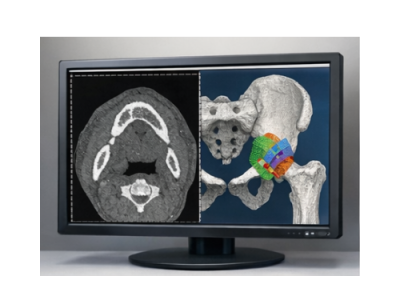
    3D printed surgical guides begin with imaging (usually CT) and precise segmentation of bone structures, followed by virtual planning of osteotomies, drilling trajectories, and implant orientation.

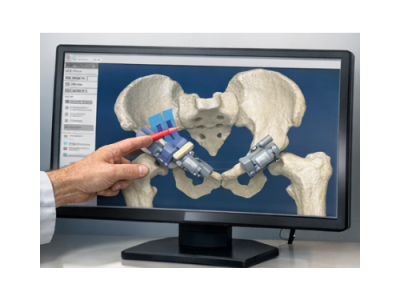
    Engineers and surgeons collaborate in CAD to design a guide that locks onto specific anatomical features (e.g., cortical surfaces, ridges, or screw holes) and incorporates slots or sleeves to direct instruments according to the plan.

    Once the design is validated, it is exported as an STL file and manufactured using an additive process such as SLS on biocompatible polymers. After printing, the guide is cleaned, inspected, and typically sterilized (e.g., steam or low‑temperature gas plasma) before being used in the operating room, where it temporarily interfaces with bone to guide the procedure.

    Why SLS and engineering‑grade polymers are a good fit

    Selective Laser Sintering (SLS) is widely used for patient‑specific surgical guides because it provides high geometric accuracy, good surface finish, and the ability to produce complex shapes without support structures. Materials such as PA11 and PA12 parts exhibit robust mechanical strength, abrasion resistance, and stable behavior under sterilization cycles, making them suitable for demanding surgical environments.

    3D printed surgical guide

    At Sculpteo, PA11, PA12, and PP are available in medical‑oriented versions that are supported by ISO 10993 and USP Class certifications for skin‑contact applications. Combined with SLS, these materials are already used for medical components such as prosthetic covers and other Class I/IIa devices, and the same properties are valuable for non‑dental surgical guides that must be strong, dimensionally stable, and safe at the bone–instrument interface.

    Digital workflow: from imaging to printed guide

    A typical workflow for producing 3D printed surgical guides involves:

    1.Imaging and segmentation

    3D printed surgical guide steps

    2.Virtual planning and CAD design

    3D printed surgical guide steps
    • Surgeons define osteotomy planes, reduction targets, and implant positions in a virtual environment.

    • Engineers or clinical designers build a guide that references stable bone regions and integrates slots, drill sleeves, or contact surfaces aligned with the plan.

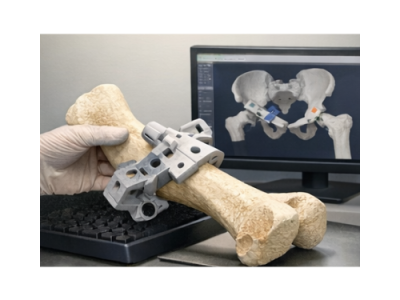
    3.Validation and iteration

    3D printed surgical guide steps
    • The design is checked for fit, clearance, and feasibility; virtual “trial placement” can be simulated on the bone model.
    • Once approved, the STL file is exported with appropriate tolerances and minimum wall thicknesses compatible with SLS.

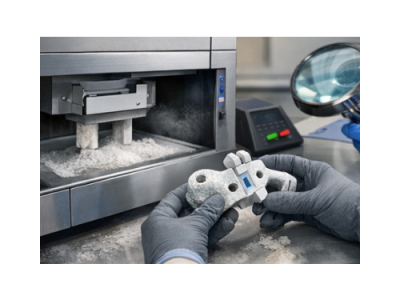
      4.Industrial 3D printing and quality control

      3D printed surgical guide steps
      • Guides are printed on calibrated SLS systems, which at Sculpteo achieve typical dimensional tolerances on the order of ±0.3% with minimum thresholds around ±0.3 mm, depending on material and size.

      • Parts are depowdered, inspected for geometry, and traced through a documented quality process when produced under medical workflows.

        5.Finishing and sterilization

        3D printed surgical guide steps
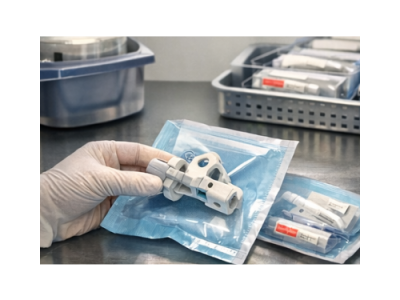
        • Depending on the use case, guides may be labeled, slightly post‑processed, and packaged for hospital sterilization.

        • Material guidelines and user instructions help ensure compatibility with common sterilization methods.

          Sculpteo’s offering for medical 3D printing

          Sculpteo operates as an ISO 13485–certified 3D printing factory, with quality management adapted to medical device regulations and specific workflows for medical components. The certification covers the production of Class I and IIa devices (for example prosthetic covers and other non‑implantable components), while explicitly excluding Class III devices from its scope.

          For medical customers, orders follow a dedicated process that includes risk analysis, documentation, and traceability from material batch to final part, in line with ISO 13485 and European MDR requirements. Combined with industrial SLS capacity on PA11, PA12, PP, and TPU, this allows hospitals and medtech companies to externalize manufacturing of patient‑specific components without investing in their own 3D printing infrastructure.

            Conclusion

            3D printed surgical guides are a key part of the broader shift toward image‑based, digitally planned surgery in orthopedics, trauma, and reconstructive fields. By turning preoperative plans into patient‑specific physical guides, they help surgeons achieve more accurate reductions and osteotomies, shorten operating time, and reduce intraoperative radiation exposure.

            Sculpteo supports this transformation with industrial SLS capacity, biocompatible materials such as PA11 and PA12, and ISO 13485–certified workflows tuned to medical components for Class I and IIa devices. For teams exploring or scaling the use of 3D printed surgical guides outside the dental field, partnering with an experienced medical manufacturing provider helps secure quality, compliance, and repeatability across cases.

            People Also Ask

            What are 3D printed surgical guides used for in orthopedics and trauma?

            They are patient‑specific tools that sit on the bone to guide saw blades, drills, or screws along planned trajectories in osteotomies, fracture fixation, and reconstructive procedures.

              How do 3D printed surgical guides improve surgical outcomes?

              By closely matching patient anatomy and preoperative plans, they reduce deviations in cut angles and implant positioning, which is associated with better functional results and fewer complications.

              Which materials are used for 3D printed surgical guides?

              Many guides are produced in SLS‑printed PA12 or similar polyamides, which offer good mechanical properties, sterilization resistance, and validated biocompatibility for skin‑contact medical components.

              Why work with Sculpteo for medical 3D printing?

              Because Sculpteo combines ISO 13485–certified quality management, SLS expertise on PA11/PA12 and other polymers, and dedicated medical workflows that help medtech companies and care providers industrialize patient‑specific devices.

              Get the latest 3D printing news delivered right to your inbox

              Subscribe to our newsletter to hear about the latest 3D printing technologies, applications, materials, and software.