
3D Learning Hub

3D Printed prosthetic leg & lower limb components

Key Takeaways

  • A 3D printed prosthetic leg enables lighter and more personalized lower limb prosthetics through digital scan-to-print workflows.
  • Industrial materials such as PA11 (Nylon) provide the durability and fatigue resistance required for load-bearing prosthetic components.
  • Additive manufacturing for O&P allows prosthetists to design customized prosthetic sockets and aesthetic covers tailored to each patient.
  • Industrial technologies like HP Multi Jet Fusion and SLS are essential for producing reliable medical-grade components.
  • Certified manufacturing partners with ISO 13485 quality systems ensure traceability, safety, and consistent production.

    Introduction

    The Orthotics & Prosthetics (O&P) industry is gradually shifting from traditional craftsmanship toward a fully digital workflow. Historically, prosthetic legs were produced using plaster casting, manual shaping, and multiple fitting adjustments. While effective, these processes can be time-consuming and difficult to standardize.

    Today, advances in additive manufacturing for O&P are transforming how prosthetic devices are designed and manufactured. Instead of relying on plaster molds, clinicians can capture the geometry of a patient’s limb using 3D scanning, then design and manufacture components digitally.

    While the first wave of innovation focused primarily on 3D printed prosthetic arms, improvements in materials such as PA11 (Nylon) and industrial printing technologies like HP Multi Jet Fusion and Selective Laser Sintering (SLS) now allow for strong and durable lower limb prosthetics. These technologies make it possible to produce load-bearing components that are both lightweight and resilient.

    A modern 3D printed prosthetic leg can therefore be designed to improve comfort, durability, and aesthetics. With the support of ISO 13485-certified manufacturing, additive manufacturing is becoming a reliable production method for prosthetic clinics, designers, and MedTech startups developing innovative mobility solutions.

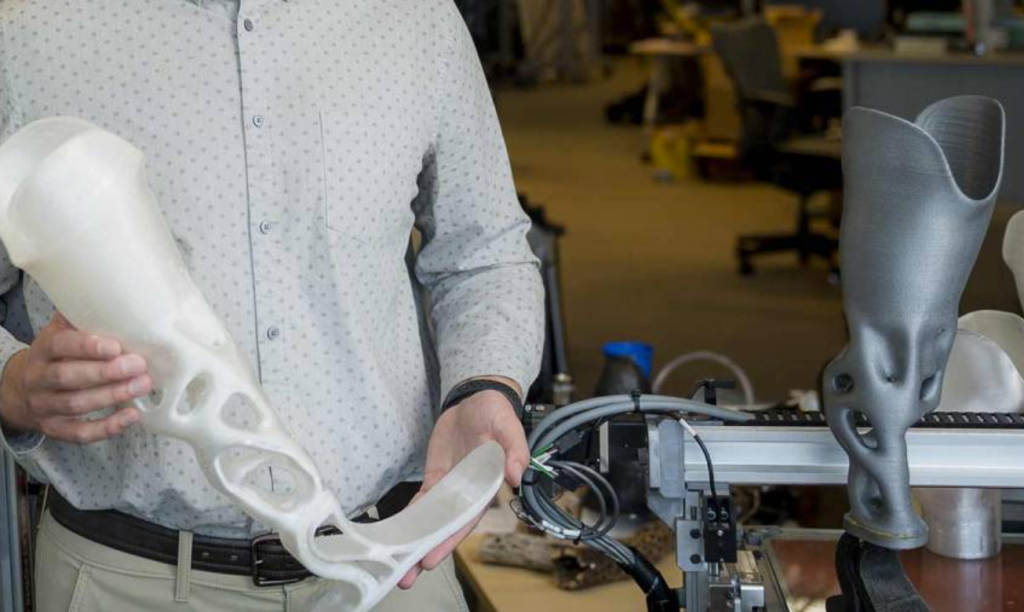
    3d printed prosthetic legs

    Why 3D Printing is changing lower limb prosthetics

    Additive manufacturing introduces new possibilities for the design and production of lower limb prosthetics. Unlike conventional manufacturing, which often restricts geometry and customization, 3D printing enables complex structures and patient-specific designs.

    One of the most significant advantages is weight reduction. Traditional prosthetic legs often combine metal pylons, laminated composites, and mechanical components. While durable, these materials can add weight that increases fatigue for the wearer during daily use. With additive manufacturing, engineers can design internal lattice structures that maintain structural strength while using less material. These biomimetic structures distribute forces efficiently, similar to the internal architecture of natural bones.

    Another key benefit is durability in challenging environments. Prosthetic devices are exposed to moisture, sweat, and daily wear. Materials commonly used in SLS and HP Multi Jet Fusion, such as PA11 and PA12, are naturally resistant to water and corrosion. This enables designs such as waterproof “shower legs,” allowing users to move confidently in environments like bathrooms or swimming areas.

    Customization is equally important. The prosthetic socket, which connects the prosthesis to the residual limb, must fit precisely to avoid discomfort or pressure points. Through 3D scanning, digital modeling and O&P software, prosthetists can design sockets that closely match the patient’s anatomy. This digital approach improves comfort while reducing the number of adjustments required during fitting.

    Beyond function: The rise of 3D Printed prosthetic covers

    Japanese inspired design - Arm prosthetic
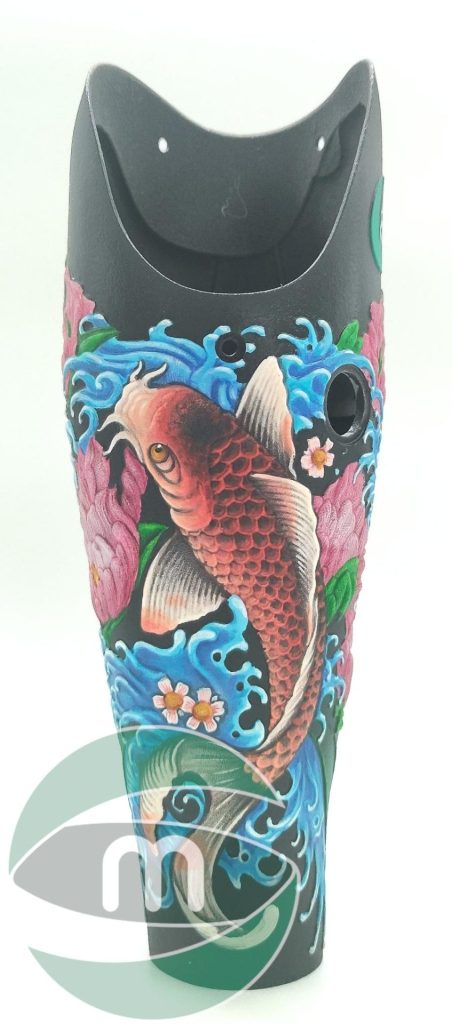
    Prosthetic cover by Make-sense

    Functionality is essential for prosthetic devices, but aesthetics also play a critical role in a patient’s confidence and self-expression. Conventional prosthetic legs typically expose structural elements such as the pylon tube, which can appear purely mechanical and medical.

    3D printed prosthetic covers, sometimes called fairings, offer an alternative. These external shells restore the natural shape and volume of the leg while protecting the internal structure of the prosthesis.

    Because they are digitally designed, these covers can be customized to mirror the shape of the patient’s sound leg. This restores visual symmetry and allows individuals to feel more comfortable with their prosthetic device.

    Additive manufacturing also enables a high degree of personalization. Prosthetic covers can incorporate organic patterns, lattice structures, or artistic designs that reflect the wearer’s personality. Some covers even include practical features such as magnetic attachments, allowing them to be easily removed for cleaning or maintenance.

    For prosthetic clinics and designers, 3D printing makes it possible to produce aesthetic components without expensive molds, enabling rapid customization for each patient.

    Best materials for 3D Printed prosthetic legs

    Selecting the appropriate material is critical when designing load-bearing prosthetic components. Industrial additive manufacturing technologies support several engineering materials that combine strength, durability, and flexibility.

    Material Key Properties Prosthetic Applications
    PA11 (Nylon 11) High impact resistance and excellent fatigue durability Prosthetic sockets, structural components
    PA12 (Nylon 12) Rigid and dimensionally stable Structural parts and prosthetic covers
    TPU (Flexible) Elastic and shock absorbing Cushioning elements and flexible soles
    Titanium (DMLS) Extremely strong lightweight metal High-stress connectors and adapters

    Among these materials, PA11 is widely recognized as one of the best options for 3D printed prosthetic legs. Its high elongation at break allows it to absorb repeated stresses without fracturing, which is essential for components exposed to daily walking loads. In addition, PA11 is derived from bio-based castor oil, making it a more sustainable material compared with some petroleum-based polymers.

    Manufacturing workflow: From scan to ship

    Producing a 3D printed prosthetic leg typically follows a digital workflow that replaces the manual processes historically used in orthotics and prosthetics.

    The process begins with 3D scanning, which captures the shape of the patient’s residual limb. Handheld scanners make this step fast, precise, and comfortable for patients.

    The scan data is then imported into CAD software, where prosthetists and engineers design the prosthetic socket and structural components. At this stage, designers can incorporate lightweight lattice structures and adjust the geometry to optimize both strength and comfort.

    Once the design is finalized, the parts are manufactured using industrial additive manufacturing technologies such as SLS or HP Multi Jet Fusion. These powder-bed fusion technologies produce parts with consistent mechanical properties in all directions, which is essential for load-bearing medical components.

    After printing, components undergo post-processing operations such as chemical smoothing. This finishing process seals the surface, improving hygiene by reducing porosity and creating a smooth finish that resembles injection-molded plastic.

      Why partner with Sculpteo? (ISO 13485 & Scalability)

      Not all 3D printing services are suited for the demanding needs of healthcare. Quality, precision, and material certification are essential.

      At Sculpteo, we bring:

      Whether you need a single organ replica for training or a complete set of anatomical parts for clinical trials, we adapt to your project’s scale and complexity.

      Conclusion

      The adoption of additive manufacturing for orthotics and prosthetics is opening new possibilities for mobility and personalization. A well-designed 3D printed prosthetic leg can combine several advantages that are difficult to achieve with traditional fabrication methods.

      Through optimized lattice structures, these devices can be significantly lighter while maintaining strength. Materials such as PA11 provide the durability required for daily use, and digital design enables precise customization of the prosthetic socket for improved comfort.

      At the same time, 3D printed prosthetic covers allow patients to express their identity and restore visual symmetry. When manufactured using industrial technologies such as SLS or HP Multi Jet Fusion, these solutions deliver both reliability and design freedom.

      For prosthetic clinics, designers, and MedTech startups developing new mobility solutions, additive manufacturing offers a scalable path toward the next generation of prosthetic devices.

      People Also Ask

      What is a 3D printed prosthetic leg?

      A 3D printed prosthetic leg is a lower limb prosthesis manufactured using additive manufacturing technologies instead of traditional fabrication methods. The process typically involves 3D scanning the residual limb, designing the prosthetic components digitally, and producing them with industrial technologies such as SLS or HP Multi Jet Fusion.

        Are 3D printed prosthetic legs strong enough for daily use?

        Yes, when produced using the appropriate industrial technologies and engineering materials. Materials such as PA11 nylon offer excellent impact resistance and fatigue durability, making them suitable for components subjected to repeated loading during walking.

        However, prosthetic components should always be manufactured using industrial 3D printing systems, as consumer desktop printers are not suitable for load-bearing medical devices.

        What parts of a prosthetic leg can be 3D printed?

        Several components of lower limb prosthetics can be produced using additive manufacturing. These include the prosthetic socket, structural components of the leg, internal lattice structures designed to reduce weight, and aesthetic prosthetic covers.

        What are the benefits of 3D printing for prosthetic customization?

        Additive manufacturing allows prosthetists to design devices based on precise digital scans of the patient’s limb. This approach improves socket fit, reduces pressure points, and allows for design features that would be difficult or impossible to create using traditional manufacturing methods.

        Why is ISO 13485 manufacturing important for prosthetics?

        Prosthetic devices are considered medical products and must meet strict quality and traceability standards. ISO 13485 certification ensures that the manufacturing process follows regulated quality management practices, helping ensure the reliability and safety of the final device.

        Get the latest 3D printing news delivered right to your inbox

        Subscribe to our newsletter to hear about the latest 3D printing technologies, applications, materials, and software.